• About

Latter-day Lamanite

Latter-day Lamanite

Category Archives: Heritage

Babylon, The Final Frontier, Part 1

02 Friday Oct 2015

Posted by latterdaylamanite in Heritage

≈ 4 Comments

Tags

Babylon, Hugh Nibley, idolatry, Idols, Zion

I served a mission on the other side of the world and when I returned, I went to the mountains of Ephraim to dwell. I saw Babylon bigger and brighter than ever. And I partook thereof until decades later, having been born of the Spirit and experiencing a mighty change of heart, I saw with new eyes how idolatrous I had been. Back then I thought worshiping idols, at least as depicted in scripture, meant nothing more than adoring or reverencing statues as the ancient Israelites did with the golden calf built by Aaron. But it is so much more than that.

The primary commandment given to Israel was to have no other gods before the Lord. Jehovah acknowledged the existence of other gods, though they were all fictions of imagination. If we love the Lord, truly love Him, there would be no need nor even use to go whoring after anything or anyone else. But the Lord’s covenant people did so and still do so. I like what Gileadi had to say in his essay, Twelve Diatribes of Modern Israel:

The final test in the scriptures of whether a god is true or false is whether he saves his people in the Lord’s day of judgment.

And so it was:

Judges 10: 13 Yet ye have forsaken me, and served other gods: wherefore I will deliver you no more.
14 Go and cry unto the gods which ye have chosen; let them deliver you in the time of your tribulation.

Isaiah 37: 18 Of a truth, Lord, the kings of Assyria have laid waste all the nations, and their countries,
19 And have cast their gods into the fire: for they were no gods, but the work of men’s hands, wood and stone: therefore they have destroyed them.
20 Now therefore, O Lord our God, save us from his hand, that all the kingdoms of the earth may know that thou art the Lord, even thou only.

Jeremiah 11:11 ¶Therefore thus saith the Lord, Behold, I will bring evil upon them, which they shall not be able to escape; and though they shall cry unto me, I will not hearken unto them.
12 Then shall the cities of Judah and inhabitants of Jerusalem go, and cry unto the gods unto whom they offer incense: but they shall not save them at all in the time of their trouble.
13 For according to the number of thy cities were thy gods, O Judah; and according to the number of the streets of Jerusalem have ye set up altars to that shameful thing, even altars to burn incense unto Baal.
14 Therefore pray not thou for this people, neither lift up a cry or prayer for them: for I will not hear them in the time that they cry unto me for their trouble.

And so it will be:

D&C 112:24 Behold, vengeance cometh speedily upon the inhabitants of the earth, a day of wrath, a day of burning, a day of desolation, of weeping, of mourning, and of lamentation; and as a whirlwind it shall come upon all the face of the earth, saith the Lord.
25 And upon my house shall it begin, and from my house shall it go forth, saith the Lord;
26 First among those among you, saith the Lord, who have professed to know my name and have not known me, and have blasphemed against me in the midst of my house, saith the Lord.

Idolatry is the great obstacle. Babylon and her idols are alive and well among the Lord’s covenant people upon the mountains of Ephraim (as well as throughout the world). It is so difficult to not be stained by it all. I cannot help but dirty my hands as I contribute to feeding Mammon, though I weep for Zion. I hate money. I hate that I have to work for money in order to exist in a system, which has too great a hold of us all. The people of Limhi learned the hard way. Today there really are no more places of refuge in the world. Above all else, I am vexed by my own sinful and carnal state. I am truly my own worst enemy.

I recently came home from visiting my parents in Texas and as I drove north along I-15, I looked toward downtown SLC at all the tall buildings and also the construction going on. I remember a time when the temple was easily visible. Now it is shadowed and eclipsed by great and spacious buildings, which recently enticed the world to partake of glamorous materialism.

If those giant posters and billboards advertising to the world to come visit the heart of Salt Lake City are disturbing, even more disturbing are the overpriced brands advertised with very attractive models. But isn’t that how all commercials are? Everyone is smiling, all made up, wearing beautiful clothes in the happy settings of Utopian society.

I’m reminded of Hugh Nibley’s words in “What is Zion? A Distant View” where he says:

Elders of Israel are greedy after the things of this world. If you ask them if they are ready to build up the kingdom of God, their answer is prompt–”Why, to be sure we are, with our whole souls; but we want first to get so much gold, speculate and get rich, and then we can help the church considerably. We will go to California and get gold, go and buy goods and get rich, trade with the emigrants, build a mill, make a farm, get a large herd of cattle, and then we can do a great deal for Israel.

I have heard this many times from friends and relatives, but it is hokum. What they are saying is, “If God will give me a million dollars, I will let him have a generous cut of it.” And so they pray and speculate and expect the Lord to come through for them. He won’t do it: “And again, I command thee that thou shalt not covet thine own property” (D&C 19:26). “Let them repent of all their sins, and of all their covetous desires, before me, saith the Lord; for what is property unto me? saith the Lord” (D&C 117:4). He does not need our property or our help.

Every rhetorician knows that his most effective weapons by far are labels. He can demolish the opposition with simple and devastating labels such as communism, socialism, or atheism, popery, militarism, or Mormonism, or give his clients’ worst crimes a religious glow with noble labels such as integrity, old-fashioned honesty, tough-mindedness, or free competitive enterprise. “You can get away with anything if you just wave the flag,” a business partner of my father once told me. He called that patriotism. But the label game reaches its all-time peak of skill and effrontery in the Madison Avenue master stroke of pasting the lovely label of Zion on all the most typical institutions of Babylon: Zion’s Loans, Zion’s Real Estate, Zion’s Used Cars, Zion’s Jewelry, Zion’s Supermart, Zion’s Auto Wrecking, Zion’s Outdoor Advertising, Zion’s Gunshop, Zion’s Land and Mining, Zion’s Development, Zion’s Securities–all that is quintessentially Babylon now masquerades as Zion.

They Who Have Buried Their Weapons

24 Thursday Oct 2013

Posted by latterdaylamanite in Heritage

≈ 8 Comments

Tags

Hopi, The Great Spirit

“The Hopi People were converted to the Great Spirit before the Great Star appeared in the sky. After they were converted, they took all the weapons they had used for the shedding of human blood and buried them deep in the earth. After burying their weapons, the faced their enemies, but would not take up weapons to fight against them. Rather than do this they would gladly die, and many of them were killed. This made their enemies ashamed and some of the aggressors would join the peaceful Hopi and bury their weapons also.

The Hopi people were great farmers who planted and harvested their crops so that they could feed the starving people in battle around them. They stayed in that country for a long time–feeding and caring for their people and theh people of other tribes that were hungry. After many years, the Hopi left the place where they were living when they were converted to the Great Spirit to migrate to another land where they could be alone and live in peace. Their greatest desire was to find a place that was peaceful.

They tied their food supplies and seeds around their waists and over their shoulders and began their migration. Many times they would not take off their supplies to rest at night because they knew they must go on–they had a long journey ahead of them. During their migration the Great Spirit spoke to them from the clouds above and directed their course, much the same as he did in the day of Moses. One day He said, “When a Great Star appears in the sky that is brighter than all other stars wherever you are at that time STOP and build houses from one to four stories high, like the homes your people lived in before they came to this country.”

…When the Great Star appeared in the sky, the Hopi stopped and built their homes as they were instructed to do by the Great Spirit. They named their first village “Shongopavi.” When they built their first village, they lived there until the babies had grown to adulthood and were having children of their own. Then they decided it was time to search for a suitable location for their second village. They were on top of a mesa looking for the proper location when they saw two huge rocks that looked like they had fallen together to form a TEPEE. Sitting within the shade of the rocks, a WHITE MAN was dropping pebbles down a squirrel hole. Looking up He arose and walked toward them with outstretched arms and said, “I am your True White Brother that has come to lead you forward and to teach you of my ways.” He stayed with them for several days and taught them things they must do to be saved…
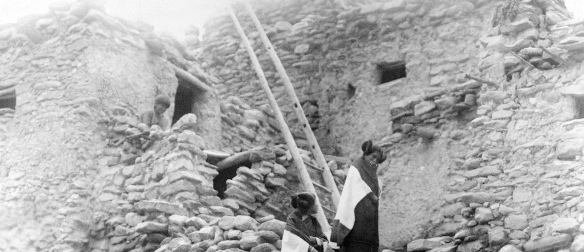
Hopi

…The White Brother said, “You are Hopi, which means ‘peaceful’ or ‘righteous people.’ You have proven faithful to the Great Spirit. Now you must cut your hair a certain way and never change it.” The Hopi haircut represents a window that their face looks out of watching and waiting for the return of the White Brother…They were told to leave their hair long in back because their long hair must be used in sacred ceremonies to veil their faces when praying to the Great Spirit…

…When the White Brother told them he must leave, the Hope begged Him to stay and be their leader. But He said, “Choose the man who led you to this country to be your leader at this time, and always follow my teachings and I will return to you in the last days and I will be your leader then. Now I must go back to my Father.”

…He then blessed the babies healed the sick and performed many miracles among them. When leaving, He started at the place where the Hopi first met Him by the “TEPEE ROCKS” and walked eastward to the end of the mesa ascending into the heavens until he faded out of sight…” Source: Chapter One, “God’s Chosen People of America” by Z. Brinkerhoff

I snatched this book from Amazon.com as soon as I learned about it and have begun studying the Hopi and their origins. It is over 250 pages and I can’t wait to finish reading it. Anybody who has carefully studied the Book of Mormon knows that the people of Ammon, who called themselves the people of Anti-Nephi-Lehi after their king’s son, Anti-Nephi-Lehi, as we read in Alma chapter 24. This is also the chapter where we read about this people burying their weapons of war for peace.

Later they migrate to Zarahemla and lived in Jershon for a time. After the Nephite/Lamanite civil wars, many people migrate by the thousands. In Helaman Chapter three, the following verses forever remains etched in my mind:

1 And now it came to pass in the forty and third year of the reign of the judges, there was no contention among the people of Nephi save it were a little pride which was in the church, which did cause some little dissensions among the people, which affairs were settled in the ending of the forty and third year.
2 And there was no contention among the people in the forty and fourth year; neither was there much contention in the forty and fifth year.
3 And it came to pass in the forty and sixth, yea, there was much contention and many dissensions; in the which there were an exceedingly great many who departed out of the land of Zarahemla, and went forth unto the land northward to inherit the land.
4 And they did travel to an exceedingly great distance, insomuch that they came to large bodies of water and many rivers.
5 Yea, and even they did spread forth into all parts of the land, into whatever parts it had not been rendered desolate and without timber, because of the many inhabitants who had before inherited the land…
12 And it came to pass that there were many of the people of Ammon, who were Lamanites by birth, did also go forth into this land.

It was approximately 45 years B.C. when they departed. Mexico is a land of many bodies of water and rivers. I believe that this people traveled northward, through Mexico and continued until they reached what is now Arizona where they finally settled down after seeing the “Great Star” appear. There is another book, which I plan on reading called, “Book Of The Hopi” by Frank Waters. Apparently, this White Brother’s name is Pahana and He promised to return again from the east. They were instructed to keep their way of building houses and also their hair style. Their way of building houses is similar to the construction of the western wall of the temple at Jerusalem. Their haircut is similar to that of the ancient Egyptians at the time that Joseph, son of Jacob, helped Pharaoh govern Egypt. Because of these instructions, many people believe that the Hopi are a remnant of the tribe of Joseph. Again, we know from the Book of Mormon that Lehi was a descendant of Joseph, as we read in 1 Nephi chapter 5:

14 And it came to pass that my father, Lehi, also found upon the plates of brass a genealogy of his fathers; wherefore he knew that he was a descendant of Joseph; yea, even that Joseph who was the son of Jacob, who was sold into Egypt, and who was preserved by the hand of the Lord, that he might preserve his father, Jacob, and all his household from perishing with famine.
15 And they were also led out of captivity and out of the land of Egypt, by that same God who had preserved them.
16 And thus my father, Lehi, did discover the genealogy of his fathers. And Laban also was a descendant of Joseph, wherefore he and his fathers had kept the records.


Genealogy

07 Friday Sep 2012

Posted by latterdaylamanite in Heritage

≈ 2 Comments

Tags

Ciudad Juarez, El Paso, Ephraim, Genealogy, Lehi, Manasseh, Mexico, San Antonio

1 Nephi 15:16 And thus my father, Lehi, did discover the genealogy of his fathers. And Laban also was a descendant of Joseph, wherefore he and his fathers had kept the records.

I have begun taking a serious interest in my lineage and will be taking over where my mother left off. She has done a considerable amount of work in tracing our lineage back a number of generations. One thing that I do know is that I was “born to a goodly lineage, even that of Ephraim, the son of Joseph who was sold into Egypt.” What’s more fascinating is that my father stems from Manasseh and my mother, from Ephraim, both sons of Joseph. My family is split with three siblings stemming from Manasseh and myself from Ephraim. My father was born and raised in San Antonio, Texas and my mother in Ciudad Juarez in the state of Chihuahua, Mexico. I was born and raised in El Paso, Texas.

Alma 10:3 And Aminadi was a descendant of Nephi, who was the son of Lehi, who came out of the land of Jerusalem, who was a descendant of Manasseh, who was the son of Joseph who was sold into Egypt by the hands of his brethren.

I look forward to connecting all those who came before me and the stories that they have to tell. It has been a challenge for my family to dig up records from Mexico. I only hope that I can make some leaps from the great steps that they have taken.


Remnant

04 Tuesday Sep 2012

Posted by latterdaylamanite in Heritage

≈ Leave a comment

Tags

Allegory, brass plates, Indian, Jacob 5, Lamanites, Mexican, Old Testament, Polynesian, Tame Wild Olive Trees, tribe of Joseph, zenos

Who exactly are the Lamanites? In the very beginning, Nephi simply referred to those who sought to destroy him as “his brethren.” Nephi’s oldest brother was Laman and it was Laman who should have inherited the role of leader but because Laman was apathetic, slothful and hard hearted, the role was passed to Nephi by the Lord. Thereafter, anyone who dissented, or who joined with any dissenters who fought against the Lord were called Lamanites after the original dissenter, whether they descended from Ishmael, Lemuel, Zoram, etc.

D&C 10:45 Behold, there are many things engraven upon the plates of Nephi which do throw greater views upon my gospel; therefore, it is wisdom in me that you should translate this first part of the engravings of Nephi, and send forth in this work.
46. And, behold, all the remainder of this work does contain all those parts of my gospel which my holy prophets, yea, and also my disciples, desired in their prayers should come forth unto this people.
47. And I said unto them, that it should be granted unto them according to their faith in their prayers;
48. Yea, and this was their faith—that my gospel, which I gave unto them that they might preach in their days, might come unto their brethren the Lamanites, and also all that had become Lamanites because of their dissensions.

Here the Lord declares that all had become Lamanites who dissented from His gospel. Eventually, however, they had all, including the Nephites, become dissenters. But my focus is solely on those who descended from Joseph, namely, Lehi’s descendants.

It is obvious that Lehi had made a serious study of the brass plates, which not only contained his genealogy, but also the law and the prophets and was as current as the time they had left Jerusalem. These plates contained prophets that our own canon in the Bible is lacking. Two prophets, whose writings have been omitted from the Old Testament as we have it, but still quoted were Enoch (quoted in the New Testament) and Zenos (quoted in the Book of Mormon). Lehi understood well Zenos’ allegory of the tame and wild olive trees, all representative of the scattering and gathering of Israel.

One of his youngest sons, Jacob, was so impressed by it that he quoted much, if not the entire allegory, recording it in his own book. Lehi and his family were keenly aware of the implications of this allegory concerning their posterity and it was their most fervent desire that their descendants, being a remnant of Joseph, be forever preserved.

If you are familiar with this allegory found in Jacob 5, I am only going to touch on a very tiny portion. I would love to expound on the entire allegory in this chapter, but another time. In D&C, verse 46 above, the Lord declares that it is because of the faith and the prayers of His prophets and disciples that their posterity were preserved, despite the fact that they were ripe for destruction.

Jacob’s own son, Enos, because of his great faith and fervent supplication, was granted this great favor:

Enos 1:11 And after I, Enos, had heard these words, my faith began to beunshaken in the Lord; and I prayed unto him with many long strugglings for my brethren, the Lamanites.
12 And it came to pass that after I had prayed and labored with all diligence, the Lord said unto me: I will grant unto thee according to thy desires, because of thy faith.
13 And now behold, this was the desire which I desired of him—that if it should so be, that my people, the Nephites, should fall into transgression, and by any means be destroyed, and the Lamanites should not be destroyed, that the Lord God would preserve a record of my people, the Nephites; even if it so be by the power of his holy arm, that it might be brought forth at some future day unto the Lamanites, that, perhaps, they might be brought unto salvation—
14 For at the present our strugglings were vain in restoring them to the true faith. And they swore in their wrath that, if it were possible, they would destroy our records and us, and also all the traditions of our fathers.
15 Wherefore, I knowing that the Lord God was able to preserve our records, I cried unto him continually, for he had said unto me: Whatsoever thing ye shall ask in faith, believing that ye shall receive in the name of Christ, ye shall receive it.
16 And I had faith, and I did cry unto God that he would preserve the records; and he covenanted with me that he would bring them forth unto the Lamanites in his own due time.
17 And I, Enos, knew it would be according to the covenant which he had made; wherefore my soul did rest.

There is an unwritten pattern in the Book of Mormon that is discernible to those who know what to look for and this pattern is also found in the Old and the New Testament as well as the Doctrine & Covenants. This pattern is the method that the Lord uses to commune with those who have, through their faith and diligence in obedience, made their calling and election sure and received the Lord as their Second Comforter as the Savior promised his apostles in the New Testament. And thus they become special witnesses and prophets who declare repentance to their people and make the path of the Lord straight among their people.

Enos was one such man who had found favor with the Lord because of his unwavering faith. And the Lord answered him, saying:

18 And the Lord said unto me: Thy fathers have also required of me this thing; and it shall be done unto them according to their faith; for their faith was like unto thine.
19 And now it came to pass that I, Enos, went about among the people of Nephi, prophesying of things to come, and testifying of the things which I had heard and seen.

The Lord declared to Enos that his father Jacob and Jacob’s father Lehi had also desired the same thing and by so acknowledging them, and also by their own words, which we read in the first books of Nephi, we know that they had also received the same gifts.

In Zenos’ allegory, we see that a small part clearly refers to the Nephite/Lamanite nation. Lehi was keenly aware of this and there is no doubt in my mind that he impressed upon his sons the fact that his family was making history and that this small band, making their way out of Jerusalem was fulfilling prophecy! This was also near and dear to Jacob’s heart and we see him expound much in 2 Nephi chapters 6-10.

Back to the allegory that Jacob included in his record. The following verse indicates the fruit of Lehi’s loins:

Jacob 5:25 And he said unto the servant: Look hither and behold the last*. Behold, this have I planted in a good spot of ground; and I have nourished it this long time, and only a part of the tree hath brought forth tame fruit, and the other part of the tree hath brought forth wild fruit; behold, I have nourished this tree like unto the others.

The tame and wild fruits refer to the Nephites and the Lamanites. Lehi and Jacob knew well their part in history and I believe the blessing they most desired of Jesus Christ was to spare their descendants that they do not utterly perish. This also became Enos’ charitable desire. Remember that faith, hope and charity go hand in hand. We cannot see Christ unless we become like Him and charity encompasses qualities that meet this requirement. Enos exemplified charity in his humble request. And so Jesus Christ grants Enos this gift as He also granted it to Jacob and Lehi.

Back to the allegory:

49 And it came to pass that the Lord of the vineyard said unto the servant: Let us go to and hew down the trees of the vineyard and cast them into the fire, that they shall not cumber the ground of my vineyard, for I have done all. What could I have done more for my vineyard?
50 But, behold, the servant said unto the Lord of the vineyard: Spare it a little longer.
51 And the Lord said: Yea, I will spare it a little longer, for it grieveth me that I should lose the trees of my vineyard.

There are times when the Lord sees that his vineyard is completely worthless and ready for the axe/fire. In His mercy, he may allow His servant to intercede. Moses was such an example of the servant of the vineyard as we read in the Old Testament concerning the wicked Israelites:

Numbers 14:11 ¶And the Lord said unto Moses, How long will this people provoke me? and how long will it be ere they believe me, for all the signs which I have shewed among them?
12 I will smite them with the pestilence, and disinherit them, and will make of thee a greater nation and mightier than they.
13 ¶And Moses said unto the Lord, Then the Egyptians shall hear it, (for thou broughtest up this people in thy might from among them;)
14 And they will tell it to the inhabitants of this land: for they have heard that thou Lord art among this people, that thou Lord art seen face to face, and that thy cloud standeth over them, and that thou goest before them, by day time in a pillar of a cloud, and in a pillar of fire by night.
15 ¶Now if thou shalt kill all this people as one man, then the nations which have heard the fame of thee will speak, saying,
16 Because the Lord was not able to bring this people into the land which he sware unto them, therefore he hath slain them in the wilderness.
17 And now, I beseech thee, let the power of my Lord be great, according as thou hast spoken, saying,
18 The Lord is longsuffering, and of great mercy, forgiving iniquity and transgression, and by no means clearing the guilty, visiting the iniquity of the fathers upon the children unto the third and fourth generation.
19 Pardon, I beseech thee, the iniquity of this people according unto the greatness of thy mercy, and as thou hast forgiven this people, from Egypt even until now.
20 And the Lord said, I have pardoned according to thy word

Also:

Psalms 106:21 They forgat God their saviour, which had done great things in Egypt;
22 Wondrous works in the land of Ham, and terrible things by the Red sea.
23 Therefore he said that he would destroy them, had not Moses his chosen stood before him in the breach, to turn away his wrath, lest he should destroy them.

Returning to the allegory:

*verse 63 Graft in the branches; begin at the last that they may be first, and that the first may be last, and dig about the trees, both old and young, the first and the last; and the last and the first, that all may be nourished once again for the last time.

Because of the intercession and intervention of His servants Lehi, and also Jacob and Enos, the Lamanites are allowed to be spared by the Lord as He spared the ancient Israelites for Moses’ sake. And so the final gathering of Israel begins with the Lamanites, bringing us to our day, the latter days.

D&C 49:24 But before the great day of the Lord shall come, Jacob shall flourish in the wilderness, and the Lamanites shall blossom as the rose.

Since those days, the Lamanites, as the Lord describes in D&C, have mingled with many other cultures, including Gentile cultures who have visited from Spain, England, France, etc. having settled in both American Continents in centuries past. As President Spencer W. Kimball once put it:

For a thousand years after the closing of the Book of Mormon record, these people wandered in spiritual darkness and were scattered upon the American continents and the isles of the sea. They lost their written language, their high culture, and, worst of all, their knowledge of the living God and his work. Faith was replaced by fear, rich language by crippled dialects, and an understanding of God and his ways by idolatry, even human sacrifice.

Since the coming of the white man to the Americas, they have been driven mercilessly, killed, and degraded. When Columbus came, these descendants of the Book of Mormon peoples and those with whom they had mixed numbered in the millions and covered the islands of the Pacific and the Americas from Point Barrow to Tierra del Fuego. But the conquerors found a prey, and in the land southward they robbed and despoiled and slaughtered in the name of gold and silver. In the land northward the 400-year “Battle of America” drove the tribal nations, much reduced in numbers, into the far corners of desolate lands. The peoples of the isles of the sea were corrupted by European and American seaman adventurers and were reduced nearly to extinction by disease.

Someone said, “If my pen might have the gift of tears I would write a book and call it ‘The Indian,’ and I would make the whole world weep,” Only the most brazen soul could fail to weep when contemplating the fall of this people, and yet it was the decree of the Lord that the Lamanites should be preserved in the land, that this remnant of Joseph should again come into their promised inheritance…So, my appeal today is for the Lamanites, all the Lamanites, the Mexicans, the Polynesians, the Indians, to live the commandments of God and prove themselves worthy of this choice land. And a further word of caution: Keep your strength up to high purpose. Keep your eye single to the glory of God. Maintain your faith and live the principles of the gospel…

The Lamanites must rise again in dignity and strength to fully join their brethren and sisters of the household of God in carrying forth his work in preparation for that day when the Lord Jesus Christ will return to lead his people, when the millennium will be ushered in, when the earth will be renewed and receive its paradisiacal glory and its lands be united and become one land. For the prophets have said, “The remnant of the house of Joseph shall be built upon this land; and it shall be a land of their inheritance; and they shall build up a holy city unto the Lord, like unto the Jerusalem of old; and they shall no more be confounded, until the end come when the earth shall pass away.” (Ether 13:8)

I remember…

25 Saturday Aug 2012

Posted by latterdaylamanite in Heritage

≈ 2 Comments

Tags

Fruitful bough, Indian, Lamanite, Mexican, Mormon, Polynesian

There was a time, back in the ’70s when the integration of Spanish speaking members with English speaking members created no small degree of discomfort. Even I, in my young age in the primary program could sense it, especially among the grown-ups. While I was oblivious to the tension it created in the various wards of my hometown of El Paso, Texas, it didn’t take too long for me to realize that I was suddenly different.

My home was no longer in the Spanish speaking ward boundary in which I had grown up and so I learned to adjust in a new ward where everyone was white. I realized at that point that speaking English wasn’t limited to just the kids. Even the adults and especially the elderly spoke perfect English, as I did. I found it odd at the time, though young and naive as I was, for previously, I had thought that English had somehow become a foreign language to adults, especially the elderly, since I never heard them speak English. I began to learn the differences between the two cultures rather quickly.

There was a combination of things that made me feel inadequate soon afterward. The members of my new ward wore finer clothes, drove nicer cars and lived in much nicer homes, some with swimming pools in their backyards. It didn’t take too long for me to feel “dark and loathesome.” I remember becoming resentful of my skin. I am grateful, though, that my parents raised my sisters and me with English as our primary language, although we were raised to speak both languages. I carried this sense of inferiority throughout my childhood and teenage years. It wasn’t until I served a mission in Munich, Germany that I came out of my shell and my self esteem began to grow, though once in a while, even today, I may feel the stigma of being brown.

I recently began reading old Ensign magazine articles and discovered one, which really touched me. It was written by the prophet, Spencer W. Kimball for his First Presidency message in the 1975 issue and directly addressed the Mexican people, the native American Indians, and the Polynesian people and is worth reading (http://www.lds.org/ensign/1975/12/our-paths-have-met-again?lang=eng).

I rejoice that it has been my privilege to carry the gospel to the Lamanites from the Pacific Ocean to the Atlantic, from the reaches of Canada to southern Chile, and in the islands from Hawaii to New Zealand. I have eaten with and visited with these my brethren and sisters and have been a guest in their homes.

I have met some who are a little bit ashamed that they are Lamanites. How can it be? Some would rather define themselves as Nephites, or Zoramites, or Josephites, or something else. Surely there must be a misunderstanding. Would they separate themselves from the great blessings the Lord has promised to his covenant people? Would they cast off their birthright? For the Lord himself has chosen to call these people Lamanites—all the mixed descendants of Father Lehi, and Ishmael, and Zoram, and Mulek, and others of the Book of Mormon record; all of the literal seed of the Lamanites, “and also all that had become Lamanites because of their dissensions.

It has been almost forty years since President Kimball’s words were published and truly the Lamanites have begun to blossom as the rose. I have spent all these years intensely studying the Old and New Testaments, The Book of Mormon and other scriptures. The Lamanites have a remarkable legacy that spans generations, even dispensations, of which is prophecied in the very first book of the Old Testament:

Genesis 49:22 Joseph is a fruitful bough by a well; whose branches run over the wall…

Newer posts →

free e-book:

  • Lecturas Sobre la Fe

Recent Posts

  • A Gold Kaleidoscope
  • After All We Can Do??
  • Rome or New Jerusalem?
  • The EVERLASTING Covenant (not that everlasting covenant).
  • Billy
  • Billy
  • Looking for Life in all the Dead Places
  • A Perfect Abortion
  • Jehovah Nissi: An Ensign to the Nations
  • “I Give Unto You A Sign…”

Translate:

Archives

latterdaylamanite

latterdaylamanite

View Full Profile →

Follow Latter-day Lamanite on WordPress.com

Enter your email address to follow this blog and receive notifications of new posts by email.

Tags

Babylon Bible Book of Mormon calling and election christianity condemnation desolating sickness Ephraim faith Genealogy Gentiles god Grace Holy Ghost idolatry Indian Isaiah Israel Israelites Jesus Jesus Christ Joseph Smith Lamanite Lamanites law of consecration Lectures on Faith Lehi Love mammon Manasseh Messiah Mexican money Mormon Moses Nephi New Covenant New Jerusalem Old Testament Overflowing scourge Polynesian prayer remnant Remnant of Joseph Second Comforter Sermon on the mount temples Tree of life tribe of Joseph Zion

Blog at WordPress.com.

  • Subscribe Subscribed
    • Latter-day Lamanite
    • Join 102 other subscribers
    • Already have a WordPress.com account? Log in now.
    • Latter-day Lamanite
    • Subscribe Subscribed
    • Sign up
    • Log in
    • Report this content
    • View site in Reader
    • Manage subscriptions
    • Collapse this bar
 

Loading Comments...