“There are many Christians who are looking for the mark of the beast. Though none seem to get what that will be, there are those who are getting closer in their guesstimates. The mark of the beast will indeed be a specific thing. However, it doesn’t come out of nowhere. Those with eyes to see recognize that it is merely the last step on a path that began some time ago.
Unfortunately, almost all of those who watch for the mark of the beast–heeding the warning of the terminal nature of the choice to accept it–are already on the path to accepting it. They don’t realize that if they criticize those who are cancelled instead of offering to help them, if they stay in a geographical place they know is not best for them and their family even when they have the ability to move, if they stay silent to protect their income even while harming their conscience, if they take a mandated experimental [vaxxine] instead of losing their job–they are already on the path to taking the mark of the beast. They are already conforming to the presently available previews of the future situation. The future situation will be much harder to avoid than these things are now. If you can’t or won’t do the right thing now, it is extraordinarily unlikely you will do the right thing later.
After six months of recording, I have finished narrating my book By A Thread which anyone may listen to freely or read freely. No need to watch it. Just listen while you drive to work, hike around the park, whatever. Each chapter is around half an hour in duration but if you’re like me, you’ll listen at 1.25 or 1.5 speed minimum. I recommend 1.25 because I narrated it rather slowly. Instead of linking the playlist, I’ll just link the final chapter titled “Sacrifice”and let you judge using it as a litmus test whether the rest of the book is worthy of your time. I believe it is. While each chapter is a standalone essay, they build upon each other to form a specific narrative arc. While it is written for and dedicated to an LDS audience, it can be appreciated by any freedom loving disciple of our Savior, Jesus Christ. Thank you to everyone who has read this book and shared it with others. I am thankful that people have found hope in reading it, especially during these turbulent times.
As gospel doctrine teacher where I attend church, I have been expounding on the Old Testament and now recently the New Testament over the last year or two in Sunday School and striving to build upon a certain theme, continually helping those who attend to aggregate information line upon line and precept upon precept using figures like Noah, Job, and others to shed light on what I probably consider not only the most important saying of Jesus Christ, but also a commandment: to be perfect without delay. This has involved teaching repetitively two concepts: idolatry and repentance. The Old Testament provided a plethora of examples to illustrate both.
In my lifetime, I have heard so many friends say that it’s impossible to be perfect in this life. But what they really mean is it’s impossible to be flawless. The way most people use the word perfect, they really mean to say without fault. And yet we readily use the word perfect to describe a sunny day, an article of clothing, or even a gift. We throw the word around with hyperbolic flair all the time: “It’s perfect!”
Jesus Christ used this word differently when He summarized a powerful sermon: “Be ye therefore perfect, even as your Father which is in heaven is perfect (Matthew 5:48).” After His resurrection, He visited the people in the Book of Mormon and taught them essentially the same sermon and summarized it with a small difference: “Therefore I would that ye should be perfect even as I, or your Father who is in heaven is perfect (3 Nephi 12:48).” Therefore many Latter-day Saints believe they will only be able to become perfect after they resurrect because of this modification and so this important sermon then gets pushed into the proverbial back burner to be given little to no more thought.
The New Testament’s usage of the word perfect was translated from the Greek word teleios which means complete and refers to a person’s integrity and maturity. The Old Testament’s usage of perfect was translated from the Hebrew word tam which means complete and also blameless. Consider the following scripture:
Job 1:8 And the Lord said unto Satan, Hast thou considered my servant Job, that there is none like him in the earth, a perfect and an upright man, one that feareth God, and escheweth evil?
God describes Job in no uncertain terms: perfect, upright, etc. How could he have been the only one on Earth to be so highly regarded? Where were the patriarchs? Did Job live after Abraham? He did not have a covenant like Noah, Abraham, or Moses did. He was not under a law like the Israelites were. He was a random guy in the Old Testament from the land of Uz and yet God said he was perfect and God is not a liar. Because of Job and others in the scriptures that were considered perfect, blameless, etc, it is reasonable to conclude that any of us can be perfect in this life, too. And because Job was perfect, he had Satan’s and God’s attention. This resulted in Job not only suffering greatly because of Satan, but he was also given a personal tour of the universe by God, and more importantly developing a personal relationship with God.
I would like to postulate the following: They who are perfect in God’s eyes are they who have reached the full degree of development that God expects of them at any given time. And as they grow in the light and as their understanding increases, so does His expectation of their degree of development. Where much is given, much is required! Are we doing everything to our best ability that we understand God expects of us? We will not be able to claim ignorance while our scriptures collect dust on our shelves either. The following image is an oversimplified bar graph of Job’s development with relation to God’s expectation:
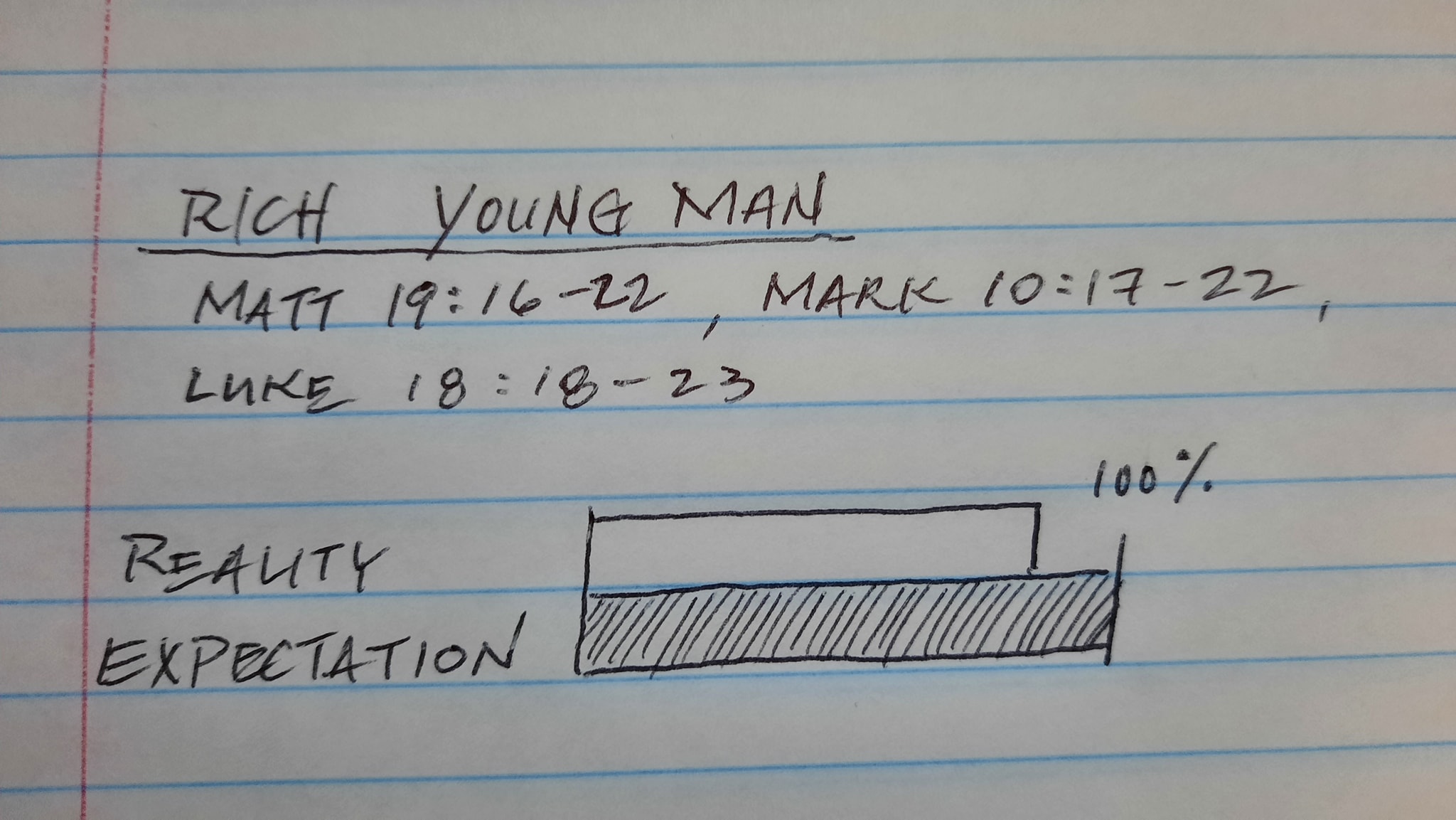
In the New Testament, a certain young ruler who was rich approached Jesus Christ, calling Him Good Master, and asked what he must do to inherit eternal life. Jesus essentially told him that he needed to keep all the commandments to which the young man said he had done from his youth up to that point. Jesus told him that he yet lacked one thing: “If thou wilt be perfect, go and sell that thou hast, and give to the poor, and thou shalt have treasure in heaven: and come and follow me (Matthew 19:21).” If this young man had done so, he would have become perfect as Jesus declared or in other words, complete and blameless and no doubt Jesus would have taught him more things and expected more things of him. Instead the young man went away sorrowful because his heart was set upon his worldly treasures. A crude bar graph of his life would look something like the following:
He was so close yet so far! He had knelt before Jesus and Jesus had loved him, but did this young ruler really believe that Jesus was the Son of God or did he consider Jesus to be just another rabbi? So Jesus challenged him asking why he called Him good. Likewise, do we really believe Jesus Christ’s sayings? Do we really believe that He expects us to be meek, to refrain from being angry with a brother, to be reconciled with others before we bring our offerings to the altar and all the other things He commanded us to be and do in His sermon? Was His injunction to “be ye therefore perfect” just an arbitrary suggestion or is it a very real and paramount expectation? What would a bar graph look like for any of us today?
Are we slothful in our discipleship? Are we striving to learn everything that proceeded from Jesus Christ’s mouth and to do all that He said to do and to become all that He said to become? Are we aligning ourselves with ALL that we understand that God expects of us? If we are not aligned with Him, we will inevitably stray off the straight and narrow path. We must be oriented toward Him alone. To deviate from this path is to miss the mark. The Hebrew word for this is hata which means to stray or miss the mark. The English translation of this is to sin. How do we not sin? How do we ensure that we do not miss the mark or stray from the path? He gave the Nephites slightly different words than He did the Jews who needed to be more righteous than the Pharisees. In His sermon to the Nephites, He added:
3 Nephi 12:19 And behold, I have given you the law and the commandments of my Father, that ye shall believe in me, and that ye shall repent of your sins, and come unto me with a broken heart and a contrite spirit. Behold, ye have the commandments before you, and the law is fulfilled.
20 Therefore come unto me and be ye saved; for verily I say unto you, that except ye shall keep my commandments, which I have commanded you at this time, ye shall in no case enter into the kingdom of heaven.
The “Sermon” wasn’t a set of suggestions. We are commanded to obey it. God expects us to become perfect and we can do that right now according to our best understanding. But we must do everything that we believe in our hearts that Jesus Christ would do in our place and not do anything that we believe in our hearts that Jesus would not do if He were in our place. Whatever your understanding is right now of loving your enemies, you are expected to live by it and as your understanding of it grows, so should your actions match it and so on with all the sayings, teachings, and commandments. As you learn line upon line, precept upon precept, you must live accordingly to remain perfect from day to day. Of course we know that Jesus Christ was perfect throughout His mortal life and the standard by which we must strive to live. He lived up to everything that He knew His Father in heaven expected of Him, thus He was sinless. And when He resurrected, His perfection was enlarged as He was glorified which is why He told the people in the Book of Mormon to be perfect as He also was perfect.
The more light and truth that we accumulate and live up to, the more like Jesus we become and this should be our focus. He is the light. He is the truth. Conversely, like that rich young man who preferred his riches and to go no further, but instead turned around, whenever we decide that we have had enough light and desire no more understanding, by halting our growth, we damn ourselves. This by definition is damnation. Like flowing water that becomes stopped, we simply stagnate and eventually dry up. This is spiritual death. Don’t be like that rich young man. Take inventory of all that you know you should do and be. Then begin living up to it today. If you’re not sure how Jesus would conduct Himself or what you should work on first, prayerfully ask the Lord, “what lack I yet?” Whatever inspiration the Lord gives you, work on that. You probably already know what you should be doing (or not doing) right now. Then work on the next thing. Take it one step at a time, incrementally, line upon line, precept upon precept. We become in spirit what we do in the flesh. Strive to become perfect today.
For ten years I have had discussions with many different people about the man “dressed in a white robe” in Lehi’s vision recorded in 1 Nephi chapter 8. Some firmly believe that he was an angel or a true messenger from the Lord. Others believe that he was just a man. Lehi chose to follow this man and ended up walking through darkness for many hours until he finally decided to pray to God for help. What do we know of this man? We know only two things:
1. He was a man. 2. He was dressed in a white robe.
Lehi’s vision initially placed him in a dark and dreary wilderness. After he decided to follow this man, he discovered that he had been led into a dark and dreary waste and there is no more mention of this man. Finally after many hours of traveling in the darkness, he prayed for mercy. It wasn’t until after he prayed that he beheld an enormous field with a very special tree in the field whose fruit was “desirable to make one happy.”
But this was not Lehi’s first vision. In the very first few verses of the very first chapter of the Book of Mormon we read about Lehi’s vision where he sees God sitting on His throne and then he sees One descending whose “luster was above that of the sun at noon-day..” Then twelve others follow Him and “and their brightness did exceed that of the stars in the firmament.”
But the man who asked Lehi to follow him in his second vision of the tree of life had no glory or brightness to speak of, yet Lehi chose to follow him. The most elect of God’s people are also willing to and readily follow men who dress in white without question just as Lehi followed this man who had no glory or brightness. There is no shortage of men (and women) in this world who desire that anyone and everyone follow them with mottos and promises of rewards. There are many gospels of success and prosperity for the right price. Satan himself may be transformed as an angel of light ready to deceive anybody willing to pay attention. Korihor was deceived by Satan who had appeared to him in the form of an angel. In the Pearl of Great Price, however, when Satan appeared to Moses in chapter one, Moses could tell that he had no glory to speak of, unlike God who had just spoken to him while His glory was upon Moses, so Moses could discern the difference and had the presence of mind to reject Satan.
Some readers of the Book of Mormon might think it should have been important enough to God to make this man dressed in white identifiable (Nephi in another vision identified a different man in a white robe as John but this is another discussion). But I consider the anonymity of the man dressed in a white robe in Lehi’s vision an important feature and not a fault of the vision and its intended message. We must learn by sad experience never to trust in the arm of flesh as one Old Testament Prophet did which resulted in his tragic death. Sometimes such a lack of discernment can be fatal. Oftentimes it leads to bruised egos and also humbled hearts as with Lehi who had become lost in a dark and dreary waste.
Most believers have a shallow understanding of the scriptures and the powerful lessons they teach. We are given those lessons so that we may be wiser than they were and not make the same mistakes that they did. One of the most important lessons is to trust your own connection to God. Trust the Holy Ghost which you should have received if you were baptized.
D&C 45:56 And at that day, when I shall come in my glory, shall the parable be fulfilled which I spake concerning the ten virgins.
57 For they that are wise and have received the truth, and have taken the Holy Spirit for their guide, and have not been deceived—verily I say unto you, they shall not be hewn down and cast into the fire, but shall abide the day.
If you do not have more than a superficial understanding of the scriptures or the breadth and depth of knowledge and wisdom which they impart, it is incumbent upon you to study them in order to know how Satan operates in all his subtlety. But more importantly, studying and pondering them deeply and doing what God has taught and commanded brings you in harmony with Him. And if you are attuned to His voice, you will know when any man dressed in white, though well intentioned he might be, is leading you–whether naively or deliberately–from the dark wilderness you now occupy into a dark waste.
We live in a world where the vast majority of us operate our lives in shades of gray. We relate to one another more easily in this vast Telestial and dreary sphere. Very few, if any, operate at the opposite ends of the spectrum being either black or white or in other words, utter darkness or glorious light. If you ever run into one of these two, your instinct would very soon impel you to turn around and avoid such a person. Very few would be drawn to such an individual. One such person who existed on the light end of this scale was Jesus Christ. During His mortal life, He said:
Matthew 6:24 No man can serve two masters: for either he will hate the one, and love the other; or else he will hold to the one, and despise the other. Ye cannot serve God and mammon.
There was no room in between. You were expected to drop what you were doing and never look back if you wanted to follow Him. This is why people either loved or hated Jesus Christ. Our world is full of of all kinds of permissiveness and it extends well into the lives of all who claim to follow Him. In a world of sex, drugs, and rock and roll, people permit varying degrees of pornography, graphic violence, and other vices into their homes and thus into their hearts. Furthermore, idleness and idolatry in all its colors permeate the very spaces that should be most closely guarded. We live in an age where all this information is instantly accessible by the touch and swipe of a finger.
If Jesus Christ or any such individual who operates solely in the white came into your life, he would seem weird to you. You would not want to spend very much time around him if at all. He would not care to indulge in all the things that you consider enjoyable or relaxing. Conversations with such a person would be very brief; your eyes might even glaze over. You would ultimately become bored of such a friendship and you really wouldn’t want to be around him.
We should spend our lives tirelessly pushing toward the light and striving to push all the filthy gray behind us. If you ever make friends with a person or people striving to cling only to the light and to avoid all the shades of gray, do yourself and that person a favor and cling tightly to that friendship and strive together. It is all too easy to find those who are drawn to the dark end of the scale and desire to partake in its filthy blackness. This leads to death.






 Latter-day Lamanite