• About

Latter-day Lamanite

Latter-day Lamanite

Tag Archives: Nephi

After All We Can Do??

28 Friday Nov 2025

Posted by latterdaylamanite in Heritage

≈ Leave a comment

Tags

After all we can do, Bible, christianity, faith, god, Grace, Jesus, Jesus Christ, Nephi, Parable goats sheep, saved by grace, works

Ah, the old argument between grace vs. works.

2 Nephi 25:23 For we labor diligently to write, to persuade our children, and also our brethren, to believe in Christ, and to be reconciled to God; for we know that it is by grace that we are saved, after all we can do.

Over the years, I have watched people attack this passage and argue about faith versus works, thinking that Nephi meant we are saved by grace only after and upon the condition that we have tried everything else. What they don’t realize – and I should have written this years ago – is that this statement, “after all we can do,” is a literary and rhetorical device that means “despite all we can do” or “in spite of all we can do” or even “regardless of all we can do.” Let’s rephrase that passage:

After all we can do, it is by grace that we are saved.

Let me put it another way by using a modern world example: After all I have done to fix my car, it was fixed by my mechanic. OR, my car was fixed by my mechanic after all I could do. This begins to make more sense in our modern English vernacular. You see, it doesn’t matter what you do or try to do or how many times you try to do it to be saved. It is only by God’s grace that you are saved. In other words, you can’t save yourself. That’s God’s job. That’s why He sent His son Jesus Christ. I have written two blogs about grace:

What Is Grace?

Grace to Grace

Having established that “after all we can do” is another way of saying “despite all we can do,” I want to talk a little about what we are supposed to do, and that is to keep God’s commandments. We are supposed to love God with all our heart, might, mind, and strength. Likewise, we should love our fellow man equally. This is what it means to be godly – to be like Jesus Christ. We cannot be saved by grace without actually doing what God said to do.

1 John 2:3 And hereby we do know that we know him, if we keep his commandments.
4 He that saith, I know him, and keepeth not his commandments, is a liar, and the truth is not in him.
5 But whoso keepeth his word, in him verily is the love of God perfected: hereby know we that we are in him.
6 He that saith he abideth in him ought himself also so to walk, even as he walked.

Also:

Titus 1:15 Unto the pure all things are pure: but unto them that are defiled and unbelieving is nothing pure; but even their mind and conscience is defiled.
16 They profess that they know God; but in works they deny him, being abominable, and disobedient, and unto every good work reprobate.

You see, their “works” are worthless. They do not honor God with their works because they don’t love God, and so their works have no true value or worth. Jesus explicitly declared that such people will be cast out in Matthew chapter 25. Contrast the following two scenarios:

Matthew 25:31 ¶ When the Son of man shall come in his glory, and all the holy angels with him, then shall he sit upon the throne of his glory:
32 And before him shall be gathered all nations: and he shall separate them one from another, as a shepherd divideth his sheep from the goats:
33 And he shall set the sheep on his right hand, but the goats on the left.
34 Then shall the King say unto them on his right hand, Come, ye blessed of my Father, inherit the kingdom prepared for you from the foundation of the world:
35 For I was an hungred, and ye gave me meat: I was thirsty, and ye gave me drink: I was a stranger, and ye took me in:
36 Naked, and ye clothed me: I was sick, and ye visited me: I was in prison, and ye came unto me.

37 Then shall the righteous answer him, saying, Lord, when saw we thee an hungred, and fed thee? or thirsty, and gave thee drink?
38 When saw we thee a stranger, and took thee in? or naked, and clothed thee?
39 Or when saw we thee sick, or in prison, and came unto thee?
40 And the King shall answer and say unto them, Verily I say unto you, Inasmuch as ye have done it unto one of the least of these my brethren, ye have done it unto me.
41 Then shall he say also unto them on the left hand, Depart from me, ye cursed, into everlasting fire, prepared for the devil and his angels:
42 For I was an hungred, and ye gave me no meat: I was thirsty, and ye gave me no drink:
43 I was a stranger, and ye took me not in: naked, and ye clothed me not: sick, and in prison, and ye visited me not.

44 Then shall they also answer him, saying, Lord, when saw we thee an hungred, or athirst, or a stranger, or naked, or sick, or in prison, and did not minister unto thee?
45 Then shall he answer them, saying, Verily I say unto you, Inasmuch as ye did it not to one of the least of these, ye did it not to me.
46 And these shall go away into everlasting punishment: but the righteous into life eternal

I encourage you to read all three parables in Matthew chapter 25. These three parables are interconnected and should be read in one. This chapter is your cheat sheet in life’s open book test! The first is about receiving the Holy Ghost and staying filled with the Holy Ghost. The second, is about increasing God’s kingdom with the talents that He has given you. The third, which I just quoted, is about being received into His kingdom for loving Him and our fellow man – becoming like Him by our love and obedience and our self sacrificing, or being cast out because you never really wanted to love Him or your fellow man as He loved you and everyone else. You are like a lofty branch that took the strength and nourishment from the roots and never produced any good fruit. Your only value was to be pruned away and discarded/burned.

The Man Dressed In A White Robe Reconsidered

15 Monday Apr 2024

Posted by latterdaylamanite in Heritage

≈ 1 Comment

Tags

Book of Mormon, Condescension, DescentPhase, faith, god, Jesus Christ, LecturesOnFaith, Lehi, ManDressedInAWhiteRobe, Nephi, TreeOfLife

I had not planned to share this for a long time, but the subject was broached today by an acquaintance, so I will explain why I have reconsidered what I wrote in a previous entry over a year ago.

I’ve been outspoken about that for a while in some circles, but I have also reconsidered who the man dressed in a white robe in Lehi’s dream was, based on personal experience and also with a conversation I had with a true messenger. Lehi and those like him such as Isaiah who have “ascended” to a new level of ministration are “exalted” to their new level by the Lord after experiencing a “descent” phase or a period of “abasement.” Consider a few things: Lehi had already experienced a theophany which is beyond the iron rod imagery or in other words at the “end” to which people should endure. He had already partaken of the fruit and found “rest.” I have made many videos about this “rest” and “partaking of God’s goodness” if anyone is interested in watching my Book of Mormon Spotlight videos on YouTube. We see this powerfully, but very briefly in 1 Nephi chapter 1 with Lehi’s theophany. Later, the opening scene of Lehi’s dream of the tree of life in 1 Nephi chapter 8 placed him in a lone and dreary wilderness where the white robed man asked Lehi to follow him. Lehi followed him until he found himself no longer in a dark wilderness but rather in a dark waste. Lehi essentially experienced a descent phase, or in other words, a condescension. It happened upon his consent to be guided there. Once his “abasement” period was completed, his ministration as one who then “ascended” like Isaiah to guide others to partake of the same “rest” began. And it began with Lehi guiding his family along the same path. This is why Lehi did not start out at the beginning of the iron rod in his dream, but the others did. Very few people press forward during their mortal lives with their minds and hearts set on partaking of the fruit of the tree of life, or “rest” while yet in mortality. Those that do may consent to a period of abasement or a “descent” phase where they demonstrate their willingness to serve God at all hazards (6th lecture on faith), not even withholding their lives as Lehi demonstrated when he preached repentance at Jerusalem.

Lecture on Faith 6:5 For a man to lay down his all, his character and reputation, his honor and applause, his good name among men, his houses, his lands, his brothers and sisters, his wife and children, and even his own life also, counting all things but filth and dross for the excellency of the knowledge of Jesus Christ, requires more than mere belief, or supposition that he is doing the will of God, but actual knowledge: realizing, that when these sufferings are ended he will enter into eternal rest; and be a partaker of the glory of God…

Or as the Lord asked:

Isaiah 6:8 Also I heard the voice of the Lord, saying, Whom shall I send, and who will go for us? Then said I, Here am I; send me.

Gentile Kings and Queens

22 Friday Mar 2024

Posted by latterdaylamanite in Heritage

≈ Leave a comment

Tags

Book of Mormon, Ephraim, faith, Gentile kings, Gentile queens, Jesus Christ, Manasseh, Nephi, nursing fathers, nursing mothers, scripture, Zion

Today’s entry is just a quick blurb and not at all exhaustive. I share much more in my ongoing YouTube playlist titled “Book of Mormon Spotlights.” In my studies, I noticed a hierarchy of Gentiles mentioned in various places in the Book of Mormon, but mostly within the first two books of Nephi. They are:

1. Mother Gentiles
2. Gentiles
3. Gentiles who repent
4. Gentile Kings and Queens

Consider the following and feel free to make any corrections. Nephi wrote about the Mother Gentiles (1 Nephi 13:17) who would wage war against those Gentiles (1 Nephi 13:12-16) who wanted a better life and were brought to America by the power of the Lord. In the Old Testament, the northern kingdom of Israel, also known as Ephraim was destroyed by Assyria and the people were dispersed. They assimilated into gentile nations, but dispersed Ephraim was predicted to emerge in the last days to serve as “nursing fathers” and “nursing mothers” (2 Nephi 10:9) to the remnant of the House of Israel that is restored in the end-time. These “kings” and “queens” who are also referred to as these nursing fathers and nursing mothers by Nephi and also referred to as “foster fathers” and “nursing mothers” by Isaiah will be among those Gentles who repent and become covenant people of the Lord (2 Nephi 30:2) because as many of the Gentiles as repent are the covenant people of the Lord;

Now lets fast forward to Joseph Smith’s day. Joseph Smith knew that he and the converted saints were those Gentiles (D&C 109:60) that Nephi prophesied about – and that the Book of Mormon would come by “way of the Gentile” (Title Page) – should become the Gentile Kings and Queens because of Ephraim’s birthright. This refers to spiritual kings and queens and not political kings and queens. There are NO kings and queens on the Earth who care about Zion. They – meaning world leaders and leaders of nations – love Babylon and all her riches and power and don’t care at all about Zion.

In order to understand this concept better, we need to go back to Genesis chapter 48 where Jacob blesses his grandsons Ephraim and Manasseh. Remember that Ephraim was the younger brother who was given the birthright blessing of the first-born, which traditionally would have been Manasseh’s birthright. Ephraim was blessed to become a greater nation than Manasseh and that the descendants of Ephraim would become a “multitude of nations.”

Latter-day Ephraim has the birthright duty to bring the fullness of the gospel to his brother, Latter-day Manasseh, and also his other brethren of the House of Israel (D&C 103:1). Those of us who have been through the temple know that we have been anointed to become kings and queens but that we will not see this realized except through our faithfulness. How do we know what serving as kings and queens involves unless we learn how the scriptures define those roles and then begin emulating those who had those roles? How can we expect to be exalted as those kings and queens IF we never serve or know how to serve, using the role models provided in the scriptures of what those kings and queens actually did? One example would be Ammon, son of King Mosiah who selflessly declined becoming the next political king and instead became a spiritual king to serve his heathen brothers and sisters, the Lamanites in the form of a lowly servant to the vassal king Lamoni.

You get the idea. Then Jesus Christ gives a sequence of events in 3 Nephi chapter 21, which are already underway. But there are still a number of great events which I consider will be the great and marvelous work (although it began with Joseph Smith). But pay attention to how many times Jesus Christ declared, “…and then shall…” and it will become clear just how much is yet to happen. But these events will be sequential. 3 Nephi chapter 21 is a great chapter to study deeply.

Great Are the Words of Isaiah

19 Wednesday Feb 2020

Posted by latterdaylamanite in Heritage

≈ 2 Comments

Tags

Assyria, Babylon, Gomorrah, idolatry, Idols, Isaiah, Israel, Jesus Christ, Lehi, Lot, Nephi, Sodom, Zion

It was about 2012 when I decided to make a serious study of the book of Isaiah in the Old Testament and for about two years, I focused on this book alone.

3 Nephi 23:1 And now, behold, I say unto you, that ye ought to search these things. Yea, a commandment I give unto you that ye search these things diligently; for great are the words of Isaiah.
2 For surely he spake as touching all things concerning my people which are of the house of Israel; therefore it must needs be that he must speak also to the Gentiles.
3 And all things that he spake have been and shall be, even according to the words which he spake.

Those are the very words out of the mouth of our Savior, Jesus Christ when He visited the people in the land Bountiful. I no longer wanted to skip over the Isaiah chapters in Second Nephi and because of my intensive studies of Isaiah’s words, I no longer wade through these Isaiah chapters with weariness, but rather, I relish reading them today.  There are four remarkable commentaries on Isaiah’s writings found in the Book of Mormon. They are given by Nephi, Jacob, Abinadi, and our Lord and Savior Jesus Christ when He visited the people at Bountiful.

(Background) In a nutshell

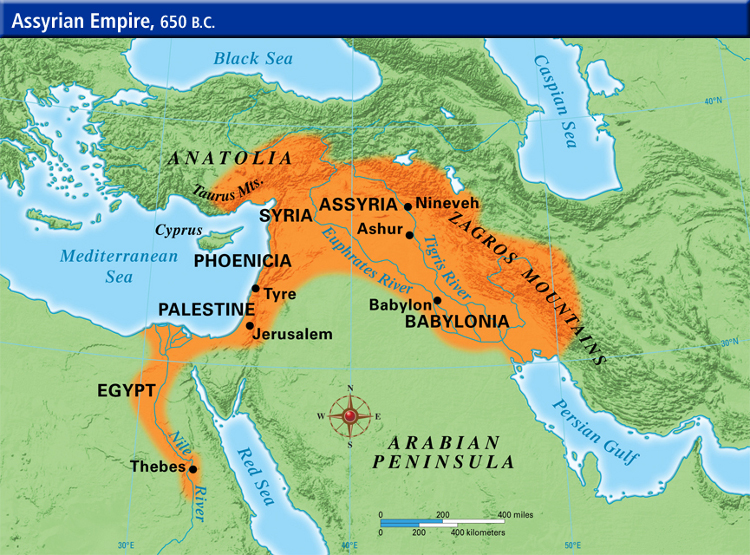
The Assyrians occupied the upper Mesopotamia. For centuries they killed and conquered nations from Egypt to Persia and built their mighty empire on their ruins. Once conquered, the enemies were brutally tortured in order to make an example of any who would rebel. Walls and stone carvings depicted images of people being skinned alive, burned to death, children being blinded before their parents and many more violent and unthinkable barbaric brutalities.

It is no wonder that Jonah fled rather than accept his divine assignment to preach repentance to them at Niniveh. But the terror of his stay inside the belly of a whale caused him to finally humble himself sufficiently to fulfill his mission. And to his amazement, they did repent. But this only lasted about forty years before they were spilling blood again.

During the height of its power, Assyria made a continuous assault on the northern kingdoms of Israel and in 721 BC, succeeded in its conquest, carrying off of to Assyria the last major segment of the Israelites. After Assyria’s fall, however, these people migrated northward and became known as the “lost tribes of Israel.”

The fall of this empire was prophecied by Isaiah, but so strong was this empire and huge and vast, was the capital of Niniveh, that people laughed and scoffed at him. Where once, Assyria was a small northern province of Babylon, it had become a super power. By the time that Lehi would have been born, Assyria would have ascended to the height of its power. But by the time Lehi had married and raising a family, the tide of history shifted. Babylon became increasingly agitated and an uprising was soon at hand.

The fact that hordes of barbarians from the north began descending to loot the mighty Assyrians enabled Egypt to break away. Then Media began to rebel. The Babylonians to the South mobilized, demanding independence. About a decade before Lehi left Jerusalem, the great battle for Ninevah was fought. All dissident factions stormed the city, breaching its might walls.

The Assyrians regrouped, setting up a temporary capital at Haran, where Abraham formerly lived and attempted to create a counter-offensive. It was at this time that Egypt’s ruler, Necho II realized that as much as he despised Assyrian rule, he hated the thought of Babylonian conquest more. He mobilized his armies up the highway along the Mediterranean coast of Palestine and found a surprise at the narrow pass near Megiddo. They found Josiah, king of Judah, commanding an army and blocking the way. Obviously the mountain kingdom of Judah did not want the Egyptians to succeed.

Necho had nothing against them because they were among Egypt’s best customers. But Necho was not about to let them stop him. He sent ambassadors to Josiah, saying, “What have I to do with thee, thou king of Judah? I come not against thee this day, but against the house wherewith I have war: for God commanded me to make hast: forebear thee from meddling with God, who is with me, that he destroy thee not.”–2 Chronicles 35:21

To make the long story short (trying to, anyway), Josiah refused and was killed in battle. This was about 609 BC and when Lehi was well on his way to achieving status as a prosperous citizen at Jerusalem. The fact that he lived down from the city in the land of his inheritance might have contributed to his safety while it is conceivable that Laban, with his “ten thousand” fought in the battle with Josiah.

The next few years war raged between Babylon and Assyria, supported by Egypt. Babylon had gained major traction when it’s king died and Nebuchadnezzar was crowned in his father’s place. In the process of mopping up and sweeping toward Egypt, Babylon swallowed up the tiny kingdom of Judah like a tiny crumb. He ordered his ministers to take some of the promising young Jews to be trained in the language, culture and governmental procedures of Babylon. One of the young men was Daniel and three other young Jewish men accompanied him. Eventually, through miraculous events, they proved themselves to be outstanding. Daniel ended up being the king’s top adviser and the others, administrators of Babylon.

What the Jews at Jerusalem did not know was that the Lord was setting up a series of circumstances, which would be most favorable to them. But the apostate king, Jehoiakim, despised the prophets. During the siege, he had to stop paying tribute to Egypt and begin paying Babylon, which he despised. Soon, though, he stopped paying tribute to Nebuchadnezzar. Before long, he was under attack and died. Nebuchadnezzar raided and looted the temple, then rounded up and carried away captive ten thousand people, including craftsmen and smiths. (See map below).

assyrianempire

With this historical background aside, here are some verses to ponder:

Isaiah 1:3 The ox knoweth his owner, and the ass his master’s crib: but Israel doth not know, my people doth not consider.
4 Ah sinful nation, a people laden with iniquity, a seed of evildoers, children that are corrupters: they have forsaken the Lord, they have provoked the Holy One of Israel unto anger, they are gone away backward…
10 ¶ Hear the word of the Lord, ye rulers of Sodom; give ear unto the law of our God, ye people of Gomorrah.
11 To what purpose is the multitude of your sacrifices unto me? saith the Lord: I am full of the burnt offerings of rams, and the fat of fed beasts; and I delight not in the blood of bullocks, or of lambs, or of he goats…
13 Bring no more vain oblations; incense is an abomination unto me; the new moons and sabbaths, the calling of assemblies, I cannot away with; it is iniquity, even the solemn meeting.

The ox and the ass are arguably the least intelligent of domesticated animals and yet they are both described as knowing their owner or master. Isaiah is speaking to a nation of idolaters. These are His children, His “covenant people.” Yet they do not know Him. The ox is a clean/kosher animal, which could be likened to the Israelites. The ass is an unclean animal and could be likened to all the gentiles (not of the ethnic lineage of Abraham). Both dumb animals know their owners and masters. Yet the Lord’s covenant people do not know Jehovah. The Master’s own covenant people are considered with a covenant curse. To “know” the Lord is a covenant relationship, but to NOT know Him is a covenant curse. In this passage, the Lord is exasperated by the vain temple ceremonies, which were supposed to teach His people how to come to know Him. The ancient temple ceremonies were supposed to keep the people of Israel in remembrance of the Savior’s coming sacrifice. Both ancient and latter-day rituals are symbolic of something else, but as such, they become stumbling blocks to those who are asleep.

As a side note, there is no graven image that is not a product of one’s hands. Idolatry results from consumer demand. The Hebrew word Abad means both to work  and worship. People worship the work of their hands. In this world, there is no economy without an exchange of products resulting from consumer demand. You can buy anything in this world with money. Mammon is the driving force behind the world’s economy. Babylon is the archetype of this system in the book of Isaiah. On the other hand, Zion does not require money. In Zion, all things are given and received freely. The Lord gave to us this earth and all things therein to be used freely and not by extortion or excess. Extortion and excess is exactly how the world operates. They take ownership of the things God has ordained for their use freely and charge a price for them. Excess is the result of one exalting oneself above another or others, thereby creating inequality in a society driven by an economy where money is the medium of exchange. In Zion, there are no rich because there are no poor because there is no money, there being no need for money. In Babylon, however, such behavior is the iniquity of a people. Idols, idolatry and commerce (economy) are all tools of Mammon.

Jehovah compares the ruling priests to Sodom and the laymen to Gomorrah. Sodom and Gomorrah set the precedent for a condemned people and so Isaiah uses it as an archetype to compare His covenant people to. They were abusers and ripe for destruction. And yet the Lord saved Lot and his family. Whenever the Lord is about to destroy a people, He tends to “gather” those few who have not forsaken Him, even by angels. Angels came to take Lot and his family out, even prodding him to leave before they destroyed the city. Likewise did the Lord bring out Lehi from Jerusalem and his family. Lot’s wife probably could not believe that her beautiful city could be destroyed. She was not attuned to the Spirit and couldn’t feel the warning to flee. Her heart was set upon the world in which she lived. So she turned around and was turned into a pillar of salt, good for nothing but to be trodden underfoot. Laman and Lemuel were the same as Lot’s wife. And so will all be whose hearts are set upon their riches–their idols.

And this is only the first half of chapter one. Chapter one is quite an indictment of the filthiness of Israel. She is a harlot whoring after her lusts, forsaking her bridegroom, who is quick to forgive and mighty to save. And though, as we read later in the chapter, though her sins be red like crimson, they shall become white as snow.

If we as disciples of Jesus Christ spend time in reflection and introspection, how do we compare to these ancient people of the Lord? We might be surprised to discover that we are just like they were.

Less Wi-Fi, More Nephi.

03 Sunday Nov 2019

Posted by latterdaylamanite in Heritage

≈ 1 Comment

Tags

Lectures on Faith, Less wifi, Nephi, Renaissance man

Leonardo da Vinci, born in 1452, was a polymath of the Italian Renaissance whose interests and talents included painting, sculpture, architecture, engineering, science, mathematics, anatomy, and much more. He is arguably history’s most notable Renaissance man, or in other words, he was knowledgeable and proficient in a wide range of  studies. He is known for his paintings, the Mona Lisa and The Last Supper, which is the most reproduced religious painting of all time according to Art through the Ages, 1970, pp. 450–56. He is also known for his creation of flying machines, adding machines, his work in a hospital dissecting human corpses for his anatomical studies and detailed drawings of muscles, tendons, and other visible features of the human body. As an engineer, he devised a system of movable barricades to defend Venice and also created a method for diverting the flow of the Arno river. He also produced a schematic for a single-span 720 ft. bridge for Beyazid II of Constantinople. The invention of the parachute and the crossbow have also been attribute to him.  He is quoted to say, “Obstacles cannot crush me. Every obstacle yields to stern resolve. He who is fixed to a star does not change his mind.”

Another Renaissance man was Galileo, who was a noted mathematician, physicist, musician and artist. Ibn al-Haytham, an Arab physicist, astronomer, mathematician, ophthalmologist, engineer, and inventor is sometimes referred to as the “father of modern optics.” A more recent historical figure and one of America’s first Renaissance men was Thomas Jefferson who was an architect, author, lawyer, musician, botanist, and an inventor. He played the violin, spoke at least five languages, was one of America’s Founding Fathers and the principal author of the Declaration of Independence. He also served as the third president of the United States between 1801 and 1809.

There are some remarkable Renaissance men alive today. One such man is Brian May, one of the founding members of the rock band Queen. Brian is a musician and world-renowned guitarist and songwriter who as a teenager with his father, designed and built his first electric guitar, which he named “Red Special” and still uses today. He is also a mathematician and an astronomer with a PhD in astrophysics and serves as a NASA consultant with its New Horizon Pluto mission. He also has a Bachelor of Science degree with honors in physics. In 2019 he was awarded the Lawrence J. Burpee Medal of the Royal Canadian Geographical Society for outstanding contributions to the advancement of geography. This Bohemian Renaissance man was told by a fellow astronomer during the 700th episode of BBC’s astronomy documentary The Sky at Night, “I don’t know a scientist who looks as much like Isaac Newton as you do.”

There is one more polymath I would like to credit as a classic Renaissance man. His name is Nephi and he lived in Jerusalem approximately six hundred years b.c. Nephi was a bowyer, fletcher, archer, hunter, orienteer, metallurgist, smelter, blacksmith, coppersmith, goldsmith, silversmith, carpenter, craftsman, shipwright, mariner, builder, colonizer, founding father, ruler, teacher, historian, poet, psalmist, and historian. This is not all, though. What separates Nephi from almost all other Renaissance men was his discipleship and devotion to Jesus Christ. Because of his complete fidelity and precise unwavering obedience to the Lord, which resulted in the manifestation of the Lord to this man, we add prophet to his résumé. Or as Nephi wrote:

2 Nephi 9:29 But to be learned is good if they hearken unto the counsels of God.

For as Nephi lamented in the verse before:

28 O that cunning plan of the evil one! O the vainness, and the frailties, and the foolishness of men! When they are learned they think they are wise, and they hearken not unto the counsel of God, for they set it aside, supposing they know of themselves, wherefore, their wisdom is foolishness and it profiteth them not. And they shall perish.

In other words, no matter how learned–or educated–a man is, his learning cannot save him. It only has the power to enrich him while he is in this world. And so he must perish. Don’t let scholars fool you either. Scholars may know all there is to know about God in as far as their learning about all that prophets have ever expounded, but that is not at all the same as knowing God. Knowing about God and knowing God are very different. Nephi may have known about God in his youth, but he did not begin to know God until his father, Lehi, became a visionary man. It wasn’t until the Lord revealed Himself to Lehi that Nephi thought to inquire for himself whether his father was receiving revelations from God. Nephi was initially uncertain about his father’s claims, but not quite so dubious as his older brothers, Laman and Lemuel. What separated Nephi from his brothers was his own desires.

1 Nephi 2:16 And it came to pass that I, Nephi, being exceedingly young, nevertheless being large in stature, and also having great desires to know of the mysteries of God, wherefore, I did cry unto the Lord; and behold he did visit me, and did soften my heart that I did believe all the words which had been spoken by my father; wherefore, I did not rebel against him like unto my brothers.

It wasn’t until Nephi cried unto the Lord that his heart was softened. And because the Lord softened his heart, he did believe his father Lehi. But it was Nephi’s desires to know the mysteries of God that pleased the Lord. This is our first big clue in developing a relationship with the Lord. This was Nephi’s first encounter with the Lord. His second encounter with the Lord came by way of intercession for his brothers who would not believe their father or Nephi. When Nephi cried unto the Lord in their behalf, the Lord condescended to speak to Nephi.

1 Nephi 2:19 And it came to pass that the Lord spake unto me, saying: Blessed art thou, Nephi, because of thy faith, for thou hast sought me diligently, with lowliness of heart.
20 And inasmuch as ye shall keep my commandments, ye shall prosper, and shall be led to a land of promise; yea, even a land which I have prepared for you; yea, a land which is choice above all other lands…

The Lord is inclined to bless us when we seek to bless others. Just as Lehi had interceded for the people at Jerusalem, Nephi interceded for Laman and Lemuel. Nephi’s desires, his faithfulness, and his diligence to seek the Lord proved fruitful. This is how we begin to develop a relationship with Jesus Christ. But critical to improving our relationship with Him is knowing and obeying His commandments. When we have developed a sufficient trust in the Lord, our faith must be demonstrated by our obedience, for it is our obedience that is a demonstration of our faithfulness and fidelity to His will and His work, which is simply to bring to pass the immortality and eternal life of man. After hearing the voice of the Lord, Nephi’s faith was firm:

1 Nephi 3:7 And it came to pass that I, Nephi, said unto my father: I will go and do the things which the Lord hath commanded, for I know that the Lord giveth no commandments unto the children of men, save he shall prepare a way for them that they may accomplish the thing which he commandeth them.

Contrast Nephi’s resolve with Laman and Lemuel’s murmurings:

1 Nephi 17:21 Behold, these many years we have suffered in the wilderness, which time we might have enjoyed our possessions and the land of our inheritance; yea, and we might have been happy.
22 And we know that the people who were in the land of Jerusalem were a righteous people; for they kept the statutes and judgments of the Lord, and all his commandments, according to the law of Moses; wherefore, we know that they are a righteous people; and our father hath judged them, and hath led us away because we would hearken unto his words; yea, and our brother is like unto him. And after this manner of language did my brethren murmur and complain against us.

They did not care about learning the mysteries of God or seeking after Him. Their hearts were solely set upon their possessions. Furthermore, Laman and Lemuel believed that keeping the statutes and judgments of the Lord justified them. They considered themselves righteous like the people back in Jerusalem. They did not understand that the law has no power to justify. It is the law that condemns sinners for breaking it. Or as Paul declared to the Galatians:

Galatians 2:16 Knowing that a man is not justified by the works of the law, but by the faith of Jesus Christ, even we have believed in Jesus Christ, that we might be justified by the faith of Christ, and not by the works of the law: for by the works of the law shall no flesh be justified.

But Nephi could not have learned what he did without his father first receiving revelations and experiencing his own theophany, and then disseminating his revelatory experiences to his family. This has been the pattern from the beginning. In the Lectures on Faith, we read in the second lecture:

31 Adam thus being made acquainted with God, communicated the knowledge which he had unto his posterity; and it was through this means that the thought was first suggested to their minds that there was a God. Which laid the foundation for the exercise of their faith, through which they could obtain a knowledge of his character and also of his glory.
32 Not only was there a manifestation made unto Adam of the existence of a God, but Moses informs us, as before quoted, that God condescended to talk with Cain after his great transgression, in slaying his brother, and that Cain knew that it was the Lord that was talking with him: so that when he was driven out from the presence of his brethren, he carried with him the knowledge of the existence of a God: and through this means, doubtless his posterity became acquainted with the fact that such a being existed.
33 From this we can see that the whole human family, in the early age of their existence, in all their different branches, had this knowledge disseminated among them; so that the existence of God became an object of faith, in the early age of the world. And the evidences which these men had of the existence of a God, was the testimony of their fathers in the first instance.
34 The reason why we have been thus particular on this part of our subject, is, that this class may see by what means it was that God became an object of faith among men after the fall; and what it was that stirred up the faith of multitudes to feel after him; to search after a knowledge of his character, perfections and attributes, until they became extensively acquainted with him; and not only commune with him, and behold his glory, but be partakers of his power, and stand in his presence.

With the pattern established anew in Nephi’s family, Nephi is able to grasp the weight of his unique opportunity and take advantage of it.

1 Nephi 11:1 For it came to pass after I had desired to know the things that my father had seen, and believing that the Lord was able to make them known unto me, as I sat pondering in mine heart I was caught away in the Spirit of the Lord, yea, into an exceedingly high mountain, which I never had before seen, and upon which I never had before set my foot…

Nephi had already proven true and faithful to the Lord in risking all his worldly possessions and even his own life in obtaining the brass plates, withholding nothing. His obedience and diligence evidenced his fidelity to God. In the Lectures on Faith, lecture six, we read:

7 Let us here observe, that a religion that does not require the sacrifice of all things, never has power sufficient to produce the faith necessary unto life and salvation; for from the first existence of man, the faith necessary unto the enjoyment of life and salvation never could be obtained without the sacrifice of all earthly things: it was through this sacrifice, and this only, that God has ordained that men should enjoy eternal life; and it is through the medium of the sacrifice of all earthly things, that men do actually know that they are doing the things that are well pleasing in the sight of God. When a man has offered in sacrifice all that he has, for the truth’s sake, not even withholding his life, and believing before God that he has been called to make this sacrifice, because he seeks to do his will, he does know most assuredly, that God does and will accept his sacrifice and offering, and that he has not nor will not seek his face in vain. Under these circumstances, then, he can obtain the faith necessary for him to lay hold on eternal life.

Nephi had proven himself, just as Moses and Isaiah and now his father Lehi before him had proven themselves faithful. And now Nephi was caught away in the Spirit of the Lord until he found himself upon an exceedingly high mountain where the Lord grants his desire, which is to see and understand his father’s vision. It wasn’t until the previous chapter where Lehi taught concerning a Messiah that Nephi even considered such a concept. And now he is taught concerning the condescension of Jesus Christ. When the Spirit of the Lord said, “Look!” He departed and an angel came in His stead to teach Nephi further. Neither Nephi nor Lehi were the first prophets in the record of the Book of Mormon to whom the Lord manifested Himself in the spirit. The brother of Jared had a similar experience:

Ether 3:14 Behold, I am he who was prepared from the foundation of the world to redeem my people. Behold, I am Jesus Christ. I am the Father and the Son. In me shall all mankind have life, and that eternally, even they who shall believe on my name; and they shall become my sons and my daughters.
15 And never have I showed myself unto man whom I have created, for never has man believed in me as thou hast. Seest thou that ye are created after mine own image? Yea, even all men were created in the beginning after mine own image.
16 Behold, this body, which ye now behold, is the body of my spirit; and man have I created after the body of my spirit; and even as I appear unto thee to be in the spirit will I appear unto my people in the flesh.

Nephi’s entire life experience from departing Jerusalem to traveling in the wilderness to reaching the promised land and walking with the Lord is a perfect fit of the symbolism of the vision of the tree of life and also the temple endowment ordinance. The entire first book of Nephi, in essence, is an endowment parallel with Adam and Eve’s exit from the garden of Eden and making their way through the lone and dreary wilderness, learning and obeying the commandments of the Lord in their efforts by trial and error to be brought back to converse with the Lord through the veil. We see the same with the brother of Jared and company. We see the same with the exit of the Israelites from Egypt and their journey to their promised land of Jerusalem with Moses as a true messenger. The pattern is always the same. In the New Testament, we read:

John 14:21 He that hath my commandments, and keepeth them, he it is that loveth me: and he that loveth me shall be loved of my Father, and I will love him, and will manifest myself to him.
22 Judas saith unto him, not Iscariot, Lord, how is it that thou wilt manifest thyself unto us, and not unto the world?
23 Jesus answered and said unto him, If a man love me, he will keep my words: and my Father will love him, and we will come unto him, and make our abode with him.

And so we see this exemplified in Nephi’s life. Both the Son and the Father had made their abode with Nephi:

2 Nephi 31:11 And the Father said: Repent ye, repent ye, and be baptized in the name of my Beloved Son.
12 And also, the voice of the Son came unto me, saying: He that is baptized in my name, to him will the Father give the Holy Ghost, like unto me; wherefore, follow me, and do the things which ye have seen me do.13 Wherefore, my beloved brethren, I know that if ye shall follow the Son, with full purpose of heart, acting no hypocrisy and no deception before God, but with real intent, repenting of your sins, witnessing unto the Father that ye are willing to take upon you the name of Christ, by baptism—yea, by following your Lord and your Savior down into the water, according to his word, behold, then shall ye receive the Holy Ghost; yea, then cometh the baptism of fire and of the Holy Ghost; and then can ye speak with the tongue of angels, and shout praises unto the Holy One of Israel.
14 But, behold, my beloved brethren, thus came the voice of the Son unto me, saying: After ye have repented of your sins, and witnessed unto the Father that ye are willing to keep my commandments, by the baptism of water, and have received the baptism of fire and of the Holy Ghost, and can speak with a new tongue, yea, even with the tongue of angels, and after this should deny me, it would have been better for you that ye had not known me.
15 And I heard a voice from the Father, saying: Yea, the words of my Beloved are true and faithful. He that endureth to the end, the same shall be saved.
16 And now, my beloved brethren, I know by this that unless a man shall endure to the end, in following the example of the Son of the living God, he cannot be saved.

Nephi exhorts the reader to walk that same path that he did and follow Jesus Christ diligently, obeying precisely everything the Lord commands, seeking His mysteries and seeking to be taught by Him who is no respector of persons, but gives to all liberally and does not upbraid. To the reader he declares:

2 Nephi 32:1 And now, behold, my beloved brethren, I suppose that ye ponder somewhat in your hearts concerning that which ye should do after ye have entered in by the way. But, behold, why do ye ponder these things in your hearts?
2 Do ye not remember that I said unto you that after ye had received the Holy Ghost ye could speak with the tongue of angels? And now, how could ye speak with the tongue of angels save it were by the Holy Ghost?
3 Angels speak by the power of the Holy Ghost; wherefore, they speak the words of Christ. Wherefore, I said unto you, feast upon the words of Christ; for behold, the words of Christ will tell you all things what ye should do.
4 Wherefore, now after I have spoken these words, if ye cannot understand them it will be because ye ask not, neither do ye knock; wherefore, ye are not brought into the light, but must perish in the dark.
5 For behold, again I say unto you that if ye will enter in by the way, and receive the Holy Ghost, it will show unto you all things what ye should do.
6 Behold, this is the doctrine of Christ, and there will be no more doctrine given until after he shall manifest himself unto you in the flesh. And when he shall manifest himself unto you in the flesh, the things which he shall say unto you shall ye observe to do.

In other words, if you desire to know more beyond what has been given to the general population, you have to ask and knock. You must diligently seek Him if you want to know His mysteries. You must be obedient to all His sayings. If you don’t, it is because of unbelief and slothfulness. Nephi’s final chapters carry the impact and weight of eternal salvation and damnation according to one’s faithfulness and diligence or lack thereof, which he seals up with finality.

2 Nephi 33:13 And now, my beloved brethren, all those who are of the house of Israel, and all ye ends of the earth, I speak unto you as the voice of one crying from the dust: Farewell until that great day shall come.
14 And you that will not partake of the goodness of God, and respect the words of the Jews, and also my words, and the words which shall proceed forth out of the mouth of the Lamb of God, behold, I bid you an everlasting farewell, for these words shall condemn you at the last day.
15 For what I seal on earth, shall be brought against you at the judgment bar; for thus hath the Lord commanded me, and I must obey. Amen.

Nephi was the epitome of a Renaissance man. All the knowledge and skills, which he possessed were merely talents employed diligently and faithfully in bringing to pass a great work of the Lord for the eternal benefit of countless others.  More importantly, he was fearless and unwavering in keeping with exactness all the commandments given to Him by the Lord. And that is the real lesson.


← Older posts

free e-book:

  • Lecturas Sobre la Fe

Recent Posts

  • After All We Can Do??
  • Rome or New Jerusalem?
  • The EVERLASTING Covenant (not that everlasting covenant).
  • Billy
  • Billy
  • Looking for Life in all the Dead Places
  • A Perfect Abortion
  • Jehovah Nissi: An Ensign to the Nations
  • “I Give Unto You A Sign…”
  • The Sword Of Justice Hangeth Over You

Translate:

Archives

latterdaylamanite

latterdaylamanite

View Full Profile →

Follow Latter-day Lamanite on WordPress.com

Enter your email address to follow this blog and receive notifications of new posts by email.

Tags

Babylon Bible Book of Mormon calling and election condemnation desolating sickness Ephraim faith Genealogy Gentiles god Grace Holy Ghost idolatry Indian Isaiah Israel Israelites Jesus Jesus Christ Joseph Smith Lamanite Lamanites law of consecration Lectures on Faith Lehi Love mammon Manasseh Messiah Mexican money Mormon Moses Nephi New Covenant New Jerusalem Old Testament Overflowing scourge parable Polynesian prayer remnant Remnant of Joseph Second Comforter Sermon on the mount temples Tree of life tribe of Joseph Zion

Blog at WordPress.com.

  • Subscribe Subscribed
    • Latter-day Lamanite
    • Join 102 other subscribers
    • Already have a WordPress.com account? Log in now.
    • Latter-day Lamanite
    • Subscribe Subscribed
    • Sign up
    • Log in
    • Report this content
    • View site in Reader
    • Manage subscriptions
    • Collapse this bar
 

Loading Comments...