
Tags
2 Timothy 2:15 Study to shew thyself approved unto God, a workman that needeth not to be ashamed, rightly dividing the word of truth.
I have laboriously studied this subject and finished writing this treatise just in time in order to commemorate New Moon Day tomorrow. Three and a half years ago, I wrote this blog about the Sabbath and ever since then, I have been asking myself and studying why most believers of Jesus Christ, including myself, worship on Sundays as the Sabbath when the Bible states repeatedly that the seventh day is the Lord’s Sabbath and not the first day of the week. Some believers accept Saturday as the seventh day Sabbath and believe that our current Gregorian calendar has always been correctly reckoned from Biblical events. I have found that this is incorrect and it can plainly and easily be demonstrated using the same Bible that Christians around the world claim to believe. God’s calendar has always been regulated by the moon for months and by the sun for years-a consistently timekeeping heavenly device that never needs winding.
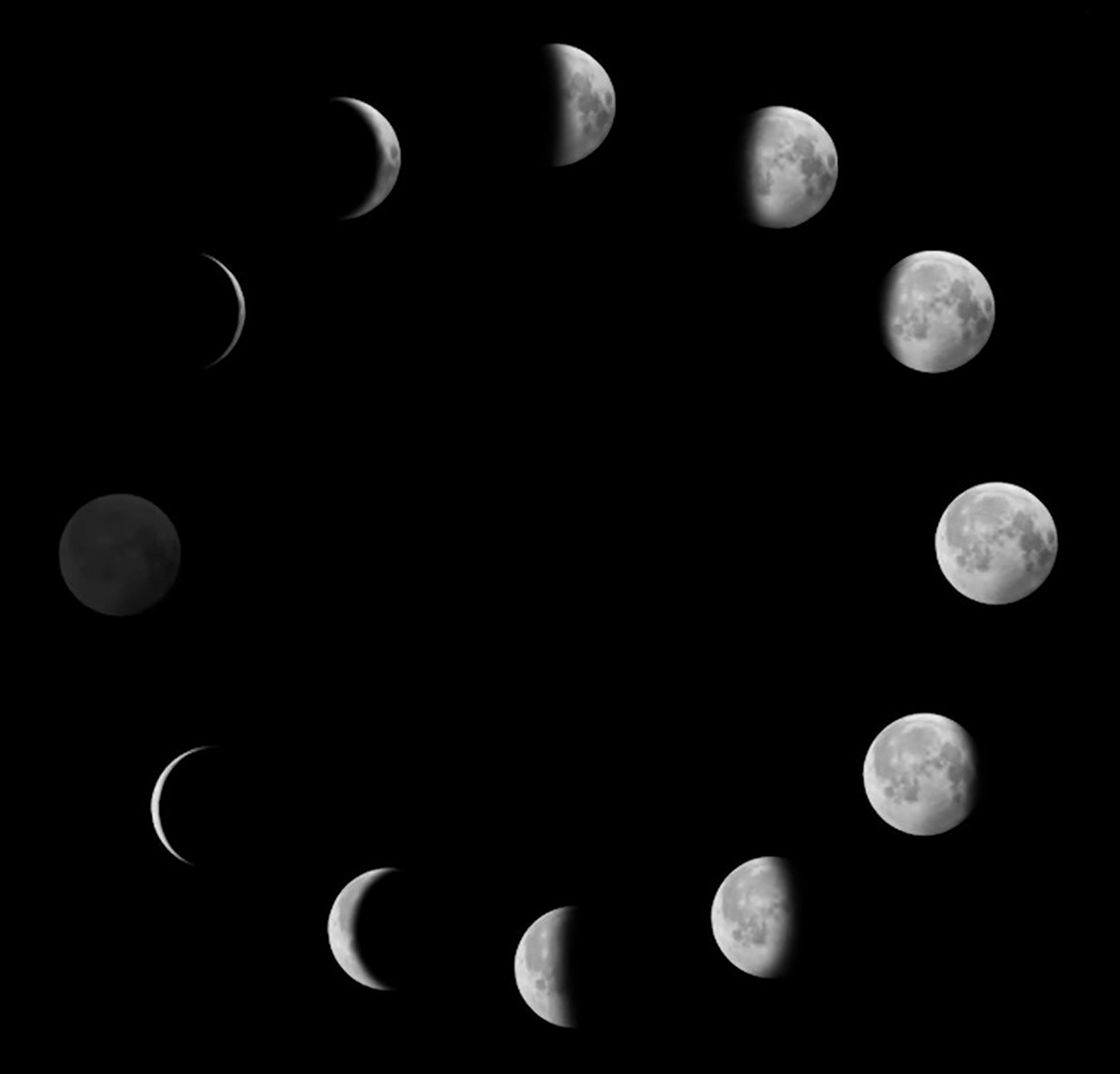
Let us consider the following scriptures:
Exodus 31:17 It is a sign between me and the children of Israel for ever: for in six days the LORD made heaven and earth, and on the seventh day he rested, and was refreshed (emphasis added).
Jeremiah 31:35 Thus saith the LORD, which giveth the sun for a light by day, and the ordinances of the moon and of the stars for a light by night, which divideth the sea when the waves thereof roar; The LORD of hosts is his name:
36 If those ordinances depart from before me, saith the LORD, then the seed of Israel also shall cease from being a nation before me for ever. (See also Genesis 1:14-18 and Psalms 136:7-9).
Leviticus 23:1 And the Lord spake unto Moses, saying,
2 Speak unto the children of Israel, and say unto them, Concerning the feasts of the Lord, which ye shall proclaim to be holy convocations, even these are my feasts.
3 Six days shall work be done: but the seventh day is the sabbath of rest, an holy convocation; ye shall do no work therein: it is the sabbath of the Lord in all your dwellings.
The original Hebrew word for feasts per Strong’s Hebrew Concordance (4150) is “moed” or appointed time. Thus feasts were actually “appointments.”
Exodus 20:8 Remember the sabbath day, to keep it holy.
9 Six days shalt thou labour, and do all thy work:
10 But the seventh day is the sabbath of the LORD thy God: in it thou shalt not do any work, thou, nor thy son, nor thy daughter, thy manservant, nor thy maidservant, nor thy cattle, nor thy stranger that is within thy gates:
11 For in six days the LORD made heaven and earth, the sea, and all that in them is, and rested the seventh day: wherefore the LORD blessed the sabbath day, and hallowed it.
Ezekiel 46:1 Thus saith the Lord GOD; The gate of the inner court that looketh toward the east shall be shut the six working days; but on the sabbath it shall be opened, and in the day of the new moon it shall be opened. (emphasis added).
Isaiah 66:23 And it shall come to pass, that from one new moon to another, and from one sabbath to another, shall all flesh come to worship before me, saith the LORD. (emphasis added).

Almost all of the Book of Deuteronomy was a New Moon Day sermon preached by Moses to the Isrealites:
Deuteronomy 1:3 And it came to pass in the fortieth year, in the eleventh month, on the first day of the month, that Moses spake unto the children of Israel, according unto all that the LORD had given him in commandment unto them.
But after a time, greedy, rich, and powerful merchants preferred the holy appointments be over so that they could return to their commerce where their hearts were:
Amos 8:4 Hear this, O ye that swallow up the needy, even to make the poor of the land to fail,
5 Saying, When will the new moon be gone, that we may sell corn? and the sabbath, that we may set forth wheat, making the ephah small, and the shekel great, and falsifying the balances by deceit? (emphasis added).
Other references:
1 Samuel 20:5, 18, 24
1 Chronicles 23:31
2 Chronicles 2:4; 8:13; 31:3
Ezra 3:5
Nehemia 10:33
Ezekiel 45:17
Hosea 2:11
Exodus 16:28-30
New Moon Day is repeatedly mentioned in the same context as the weekly Sabbath. As the first day of the month, it was a day of recommitting and a day of worship NOT to be classified with the six working days that followed before the seventh day of rest-the Sabbath. Thus, in both the Old and the New Testaments, the weekly Sabbaths are always on the 8th, 15th, 22nd, and 29th days of the month of the LORD’s appointment calendar.
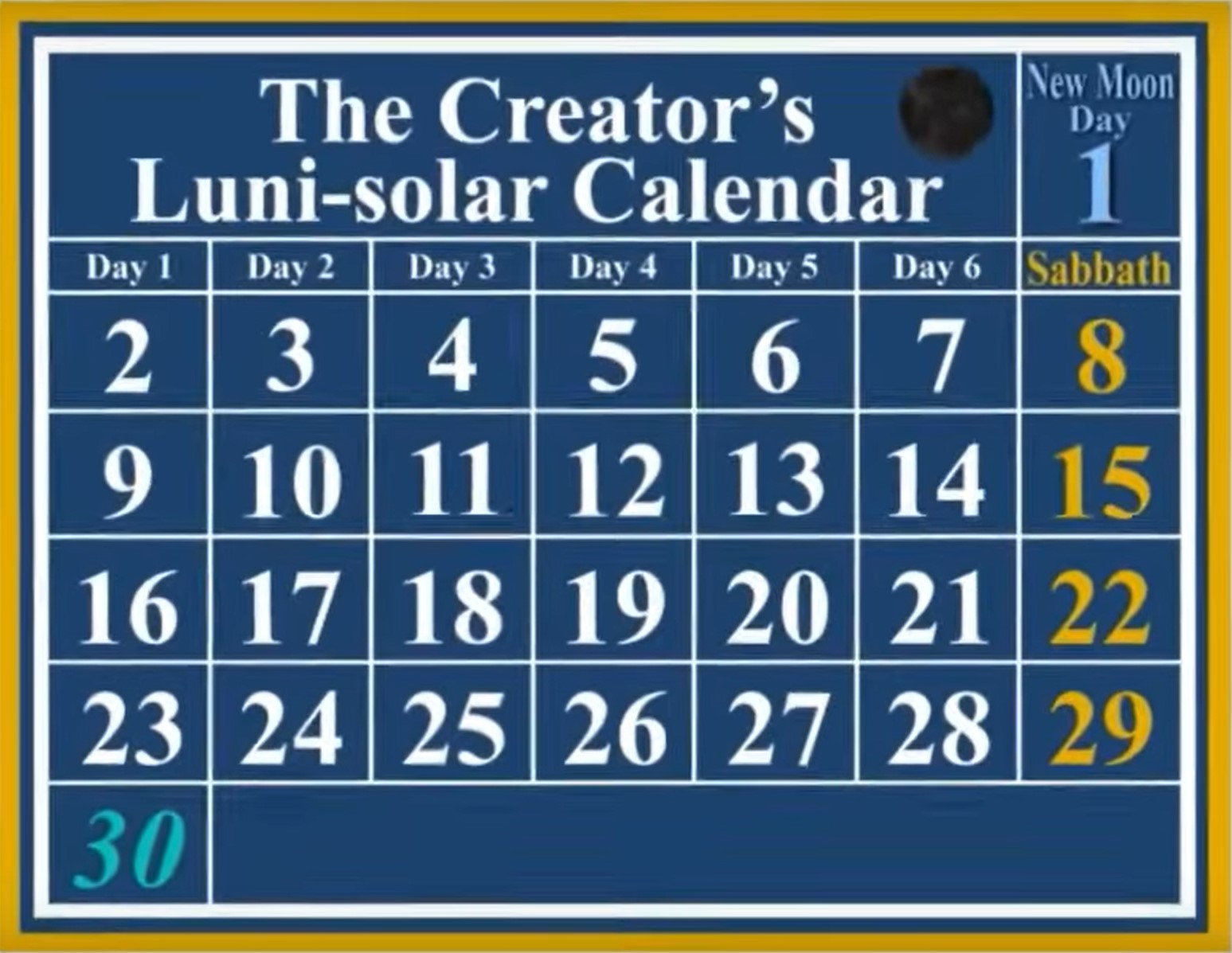
Since “appointed times” (seasons) musts be kept annually, the Israelites must by necessity have been given a calendar on which to place them.
Exodus 12:1 And the LORD spake unto Moses and Aaron in the land of Egypt, saying,
2 This month shall be unto you the beginning of months: it shall be the first month of the year to you. (emphasis added)
This established the beginning of the year for the Israelites who had lost any knowledge of the LORD’s calendar while they were in bondage in Egypt. Whenever the Bible refers to a day of the month, it literally refers to the count from the last new moon. Thus the 14th day of the month meant the 14th day counting from New Moon Day.
Exodus 12:5 Your lamb shall be without blemish, a male of the first year: ye shall take it out from the sheep, or from the goats:
6 And ye shall keep it up until the fourteenth day of the same month: and the whole assembly of the congregation of Israel shall kill it in the evening… (emphasis added).
Exodus 12:22 And ye shall take a bunch of hyssop, and dip it in the blood that is in the bason, and strike the lintel and the two side posts with the blood that is in the bason; and none of you shall go out at the door of his house until the morning.
Approximately 1500 years later, Jesus Christ declared the “day” twelve hours long. (see John 11:9).
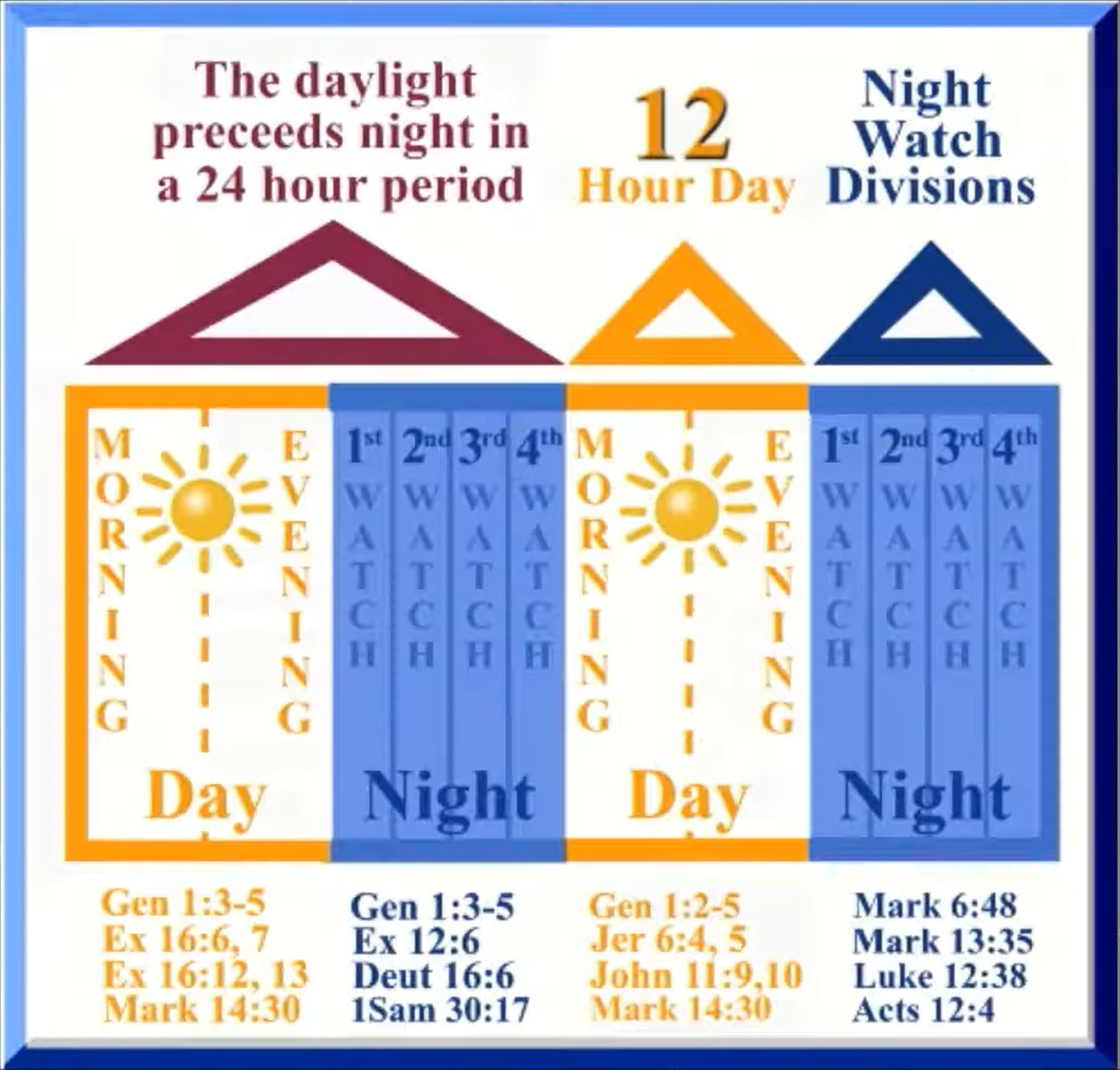
The morning following Passover began the 15th day of the month and also the 7th day of the 2nd week-the Sabbath Day.
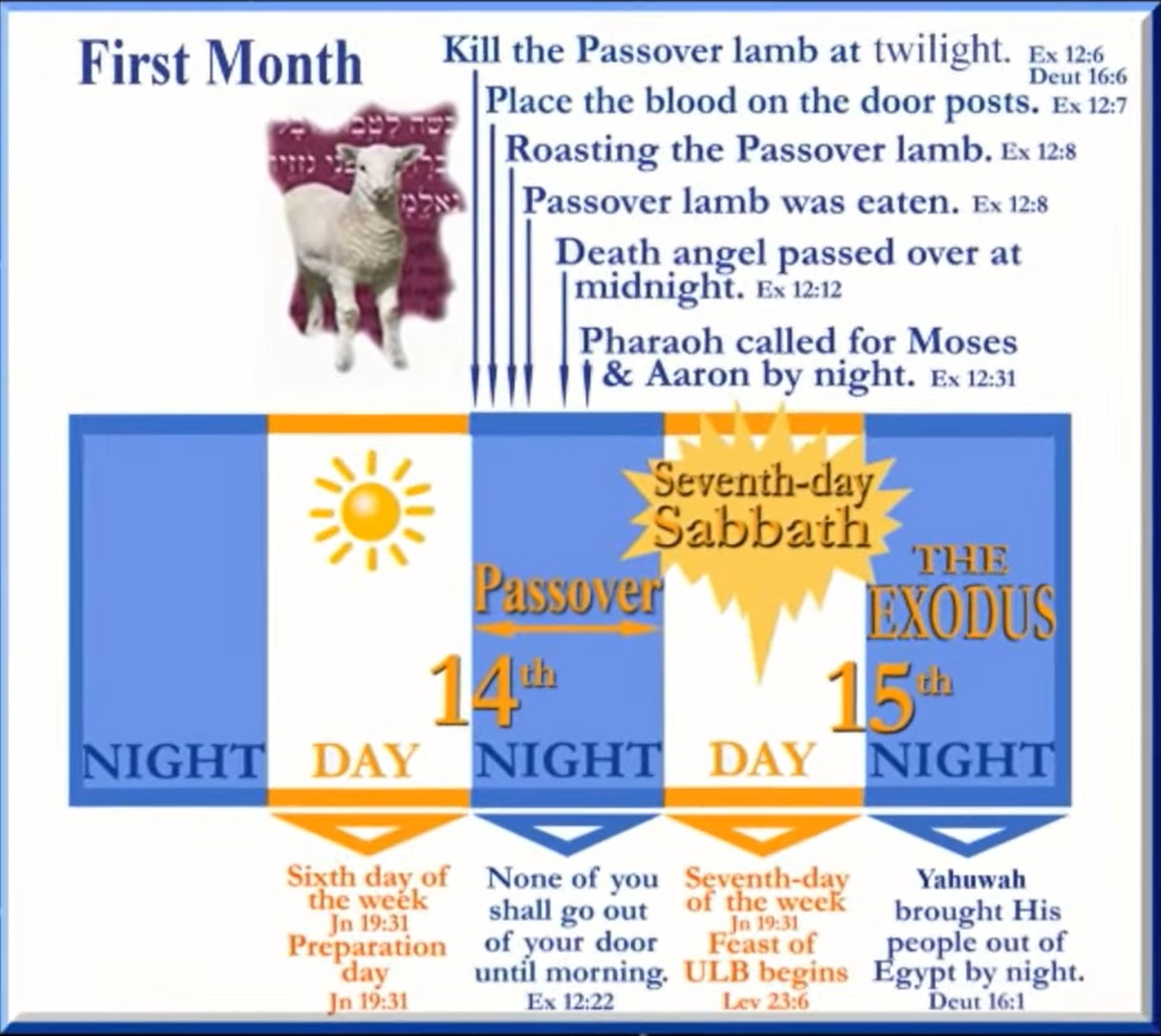
Leviticus 23:5 In the fourteenth day of the first month at even is the LORD’s passover.
John 19:30 When Jesus therefore had received the vinegar, he said, It is finished: and he bowed his head, and gave up the ghost.
31 The Jews therefore, because it was the preparation, that the bodies should not remain upon the cross on the sabbath day, (for that sabbath day was an high day,) besought Pilate that their legs might be broken, and that they might be taken away.
Jesus Christ the true Passover Lamb fulfilled the pattern established at the Exodus approximately 1500 years prior.
“On the sixth day of the week they had seen their Master die…” (Desire of Ages, p. 794).
“The Passover was observed as it had been for centuries, while He to whom it pointed had been slain by wicked hands and lay in Joseph’s tomb.” (Desire of Ages, p. 774).
This consistent calendar cycle established by the LORD at the Exodus was confirmed by the dates of the crucifixion on Preparation Day/Passover 1500 years later verifying that the 7th day Sabbath always fell on the 8th, 15th, 22nd, and 29th days of the month of the LORD’s calendar.
With the 7th day Sabbath always falling on the 8th day of the month, the 1st day of the work week always commenced on the 2nd day of the month, the 1st day of the month being New Moon Day-a holy day.

Exodus 13:8 And thou shalt shew thy son in that day, saying, This is done because of that which the LORD did unto me when I came forth out of Egypt.
9 And it shall be for a sign unto thee upon thine hand, and for a memorial between thine eyes, that the LORD’s law may be in thy mouth: for with a strong hand hath the LORD brought thee out of Egypt.
10 Thou shalt therefore keep this ordinance in his season from year to year. (emphasis added).
Again, the details of the Exodus and the crucifixion approximately 1500 years later act as bookends and establish the LORD’s consistent Lunar-Solar Calendar of the Old and the New Testaments. Each new moon reset the weekly cycles of the month with every Sabbath falling on the 8th, 15th, 22nd, and the 29th days of every lunar month without fail.
The next consecutive month, the LORD once again established the days of the month to be reckoned from the New Moon Day. Strong’s Concordance defines “month” (2320) as “Chodesh” which means both “month” and “new moon.”
The Oxford English Dictionary defines “month” as “Relating to the moon…a measure of time corresponding to the period of revolution of the moon.” (Oxford English Dictionary, 1971).
Exodus 16:1 And they took their journey from Elim, and all the congregation of the children of Israel came unto the wilderness of Sin, which is between Elim and Sinai, on the fifteenth day of the second month after their departing out of the land of Egypt.
2 And the whole congregation of the children of Israel murmured against Moses and Aaron in the wilderness…
On the Sabbath Day, exactly one month after they departed Egypt, the Israelites murmured against the Lord because they were starving.
Exodus 16:11 And the LORD spake unto Moses, saying,
12 I have heard the murmurings of the children of Israel: speak unto them, saying, At even ye shall eat flesh, and in the morning ye shall be filled with bread; and ye shall know that I am the LORD your God.
13 And it came to pass, that at even the quails came up, and covered the camp: and in the morning the dew lay round about the host.
14 And when the dew that lay was gone up, behold, upon the face of the wilderness there lay a small round thing, as small as the hoar frost on the ground.
15 And when the children of Israel saw it, they said one to another, It is manna: for they wist not what it was. And Moses said unto them, This is the bread which the LORD hath given you to eat.
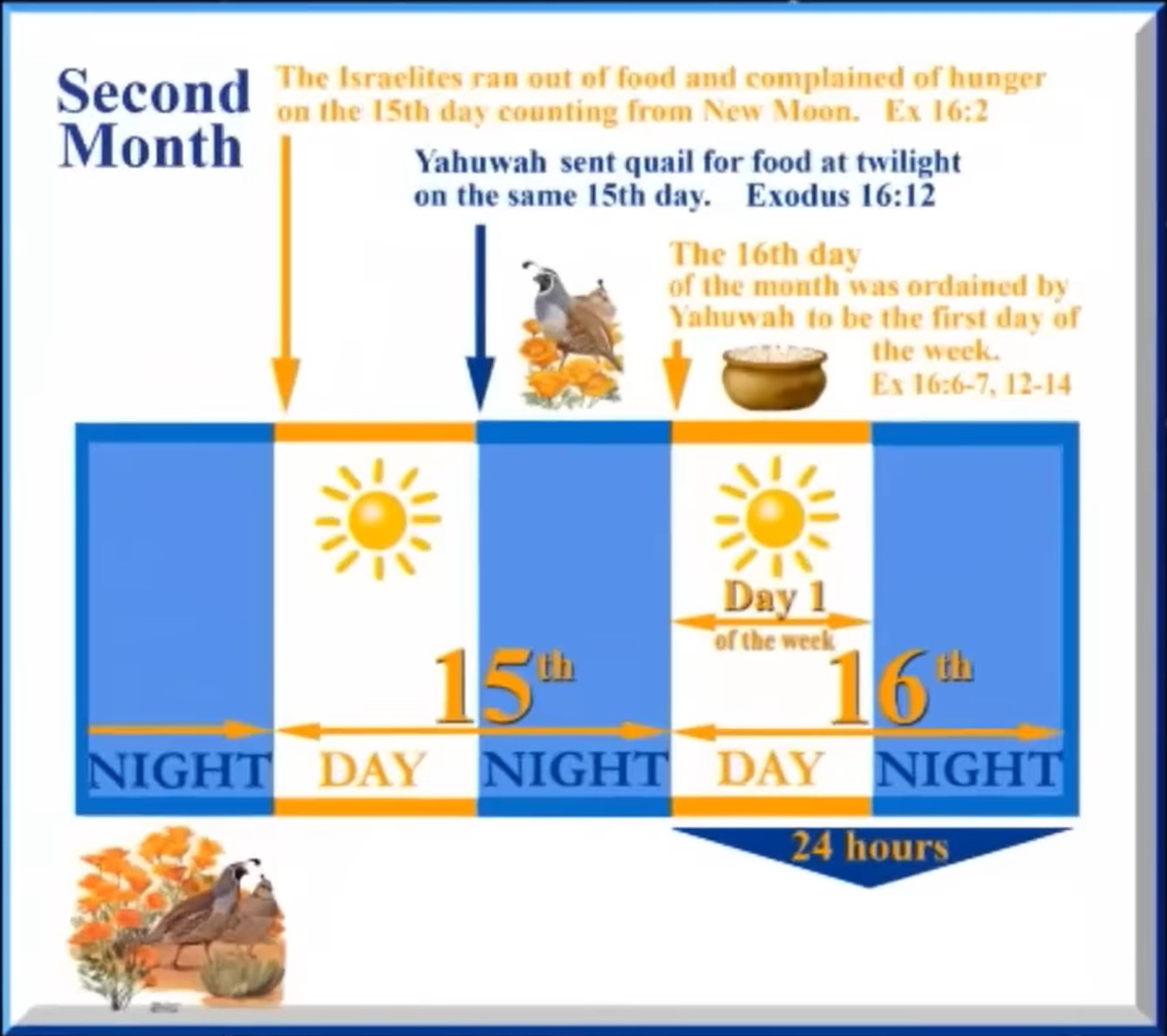
The Israelites were to gather one omer (a day measure) per person each day for five days. On the 6th day, they were to gather a double portion for that day and the next day which was the 7th day Sabbath. Scripture clearly established that manna was given on the 16th day of the 2nd month. Therefore, at the end of that week, the 7th day Sabbath fell on the 22nd day of the 2nd month.
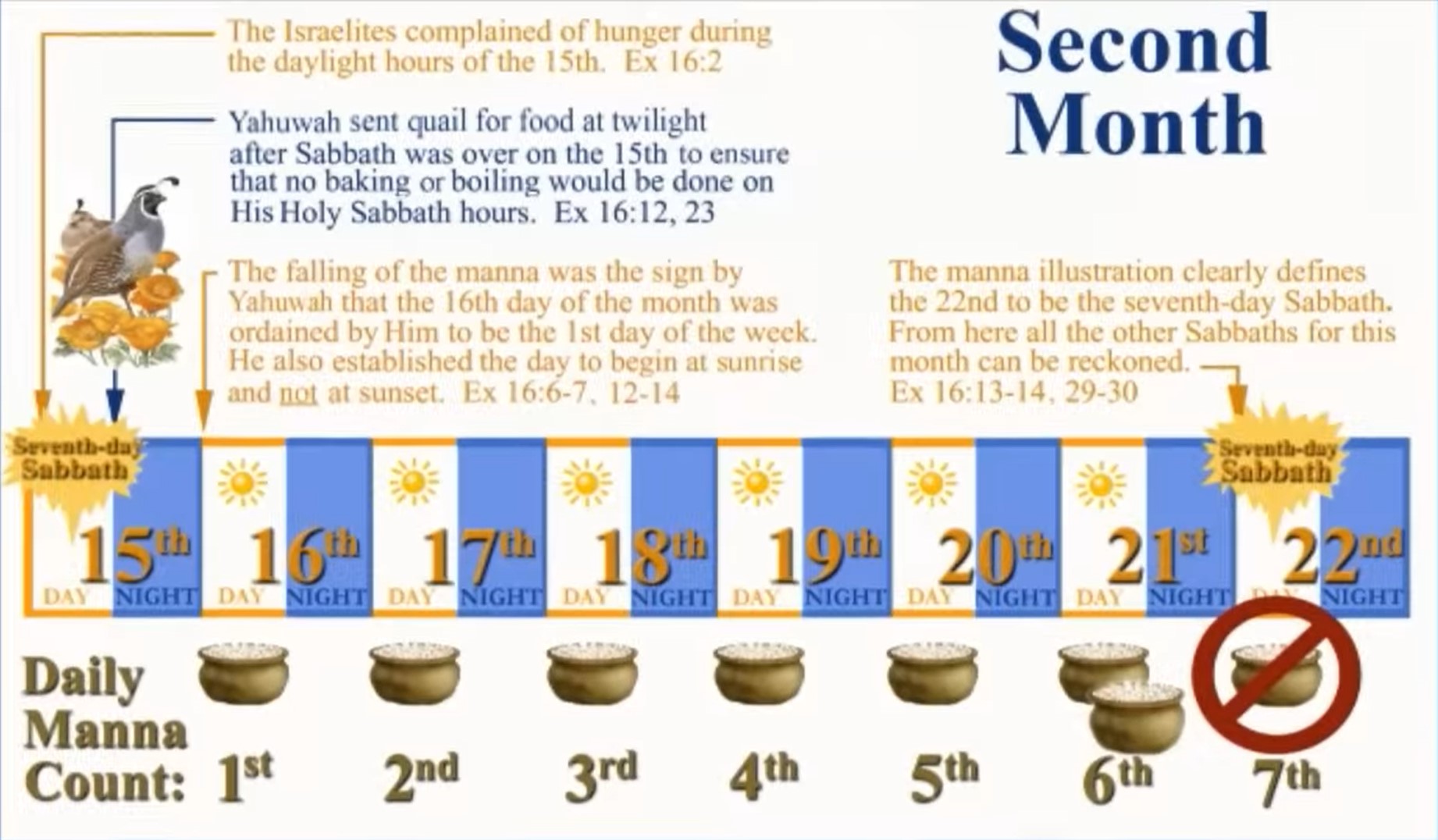
God established the 15th day of the month as a 7th day Sabbath in two ways:
- Quail on the 15th day
- Manna on the 16th day
From the dates previously mentioned following the New Moon Day, the rest of the dates for the entire second month can be extrapolated in both directions to establish all the dates of the 2nd month and verifying that the 7th day Sabbaths of each week fell on the 8th, 15th, 22nd, and 29th days exactly the same as the first month established by the Exodus.
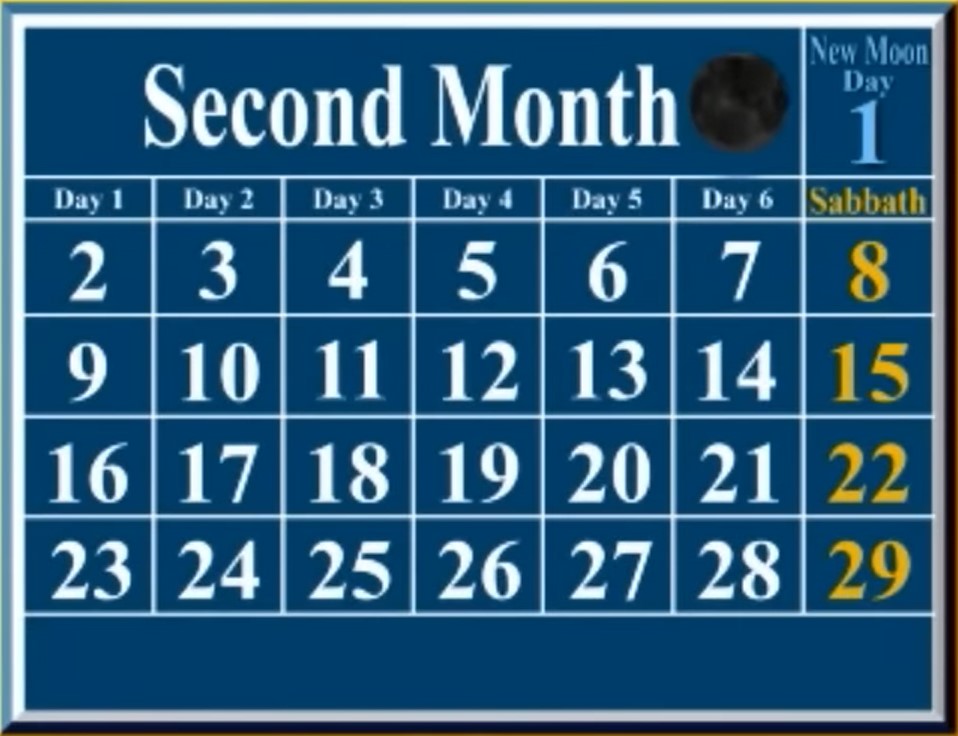
A striking fact emerges: the weekly cycle of the Biblical month is intrinsically tied to New Moon Day for two consecutive months.
The following month, the Israelites arrived at Mount Sinai on the same date which they had left Egypt two months before. Remember that they departed on the 1st month on the 15th day after Passover (Numbers 33:3).
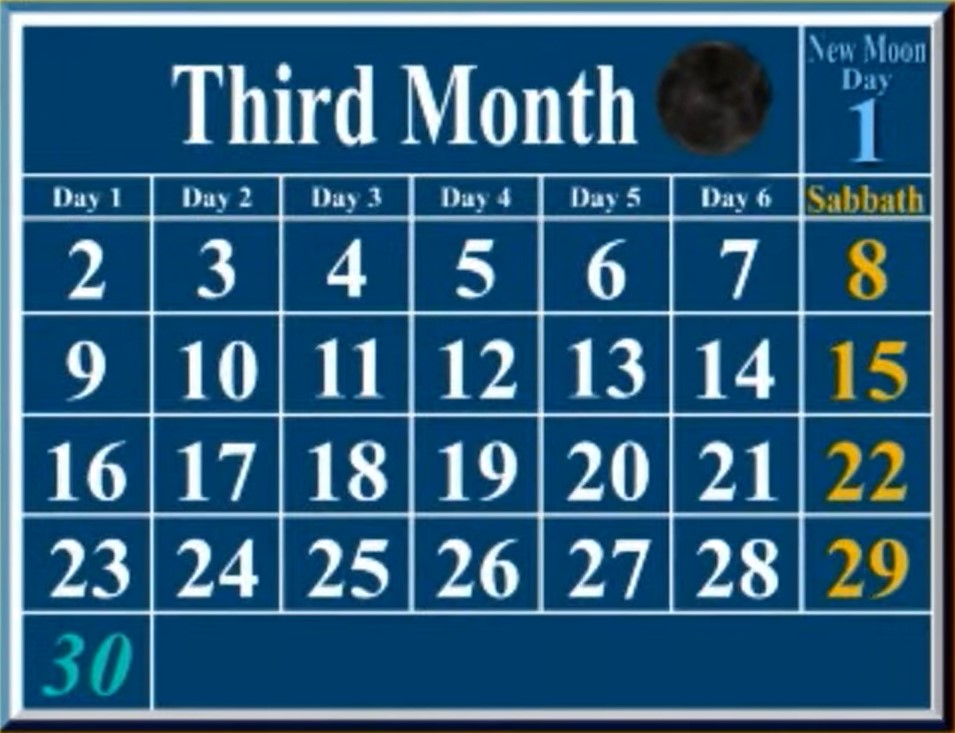
Exodus 19:1 In the third month, when the children of Israel were gone forth out of the land of Egypt, the same day came they into the wilderness of Sinai.
2 For they were departed from Rephidim, and were come to the desert of Sinai, and had pitched in the wilderness; and there Israel camped before the mount. (emphasis added).
It was after sunset of the same day that the Israelites were led out of Egypt and the LORD often led them by night which protected them from the burning heat of the desert sun. (See Deuteronomy 1:33). We might reasonably conclude that they arrived after sunset on the “same day” as the first month being the 15th day of the month.
Once more, when the 15th of the month is a 7th day Sabbath, the rest of the dates can be supplied as before to establish all the dates of the 3rd month. Once more, this demonstrates a lunar month with the first day being New Moon Day. Thus the Sabbath days are the same as the previous two months being the 8th, 15th, 22nd, and 29th.
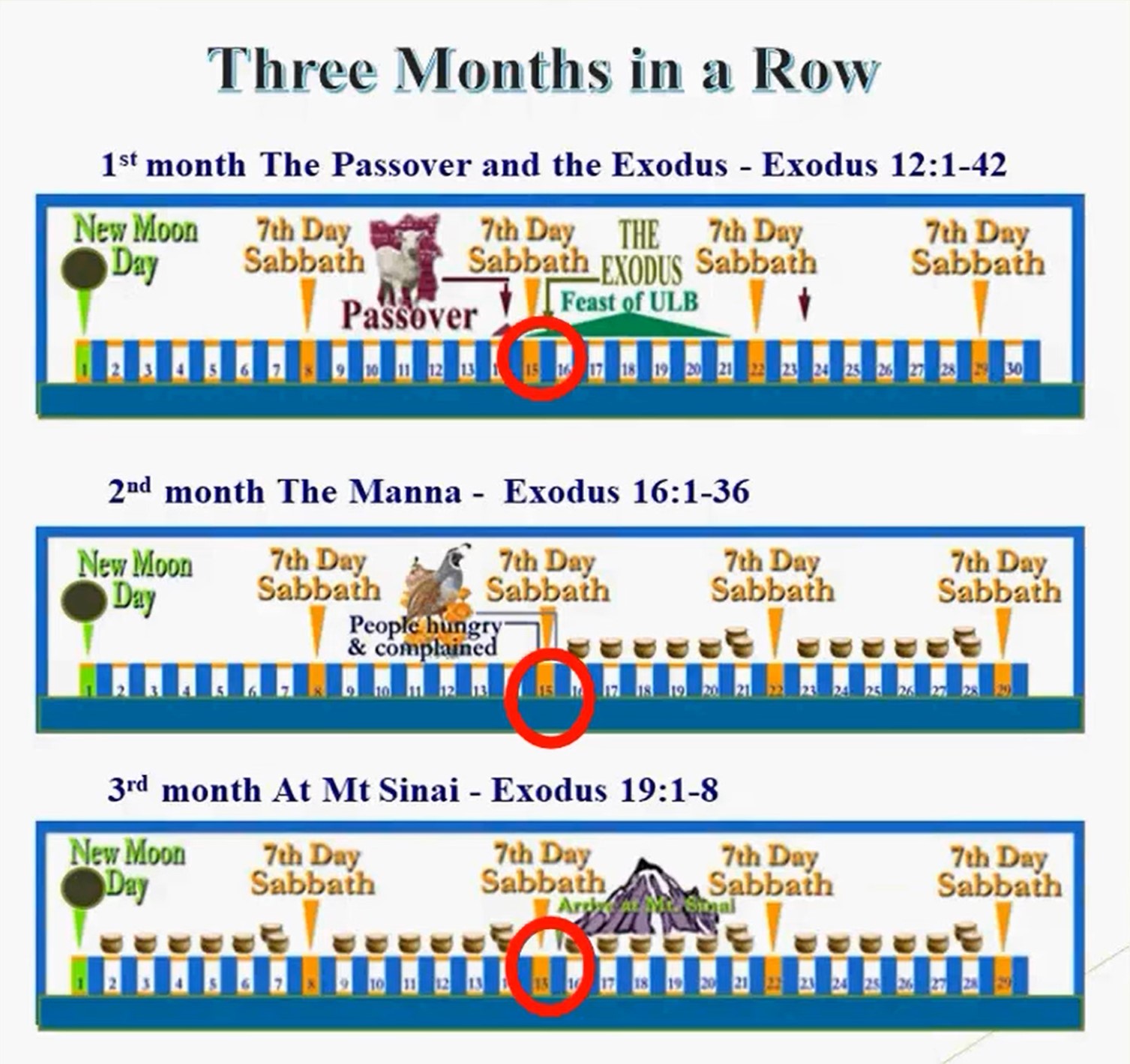
The dating of the Exodus, the falling of the manna, and the arrival at Mount Sinai reveal a calendar numbering format that is identical for three consecutive months!
Such a calendar layout is impossible on the continuous weekly cycle of our modern Gregorian calendar. These facts of the biblical account applied to a calendar demonstrate the LORD’s method of measuring time for us. Only lunar months as codified by our Supreme Creator provide an identical numbering arrangement for any given number of consecutive months. Numbering from each New Moon Day is the only way to determine the true 7th day Sabbath which the LORD set apart for rest and worship.

Forty years after manna had been initially given to feed the Israelites in the wilderness, it ceased. Thus the LORD had restored His heavenly calendar timing to his chosen people. This consistent schedule of appointments had become an integral part of their lives. And on the 16th day of the 1st month (after the Sabbath day), the manna forever stopped falling from heaven. (see Joshua 5:10-12).
Joshua’s writings were harmonious with the codified calendar recorded by Moses. Although leadership had changed, the LORD’ calendar had not. A heavenly spotlight continued to highlight three consecutive days to verify the continuity of timekeeping under Joshua’s leadership even after forty years:
- Preparation Day/Passover on the 14th day.
- Feast of Unleavened Bread on the 15th day (Sabbath).
- “First day of the week” on the 16th day.
Both the LORD and Joshua punctuate that the 14th day of the 1st month remains the Feast of Passover and the 6th day of the week. The LORD does this by sending the double portion of the manna from heaven for the lat time, and Joshua does it by recording this monumental event. The LORD established that the 15th day of the 1st month is consistently the Feast of Unleavened Bread as well as the 7th day Sabbath for the entire duration of forty years and even into the time of the Promised Land.
Consider the following biblical facts about the LORD’s calendar:
- Manna was given for five days with a double portion on the 6th day of the week. None was provided on the 7th day Sabbath.
- The schedule of the manna provided illustrated full, complete weeks, thus defining the LORD’s calendar and its Sabbaths.
- The LORD would have undermined and subverted His own calendar if He were to cause the manna to cease randomly and start again randomly.
- The 14th day of the 1st month forty years after the Exodus was the last day that manna was provided with its double portions for the Sabbath, completing a full week.
- No food preparation was to be done on a 7th day Sabbath (8th, 15th, 22nd, & 29th days of the month).
- The 15th was the first day of the Feast of Unleavened Bread which made it a feast Sabbath.
- The Israelites ate unleavened bread on the 15th which had been prepared on the day before on the 14th.
- On the Sabbath Day, no manna was provided, but the extra portion gathered the previous day did not go bad as it would have on any other day. (Exodus 16:22-24)
- On that Sabbath in the Promised Land, Israel’s diet consisted of unleavened bread and parched corn from the fields.
- For decades on the first day of each week, it was expected that manna would fall again after the Sabbath Day where no manna was provided.
- It is clearly stated in scripture that the manna “ceased on the morrow after they had eaten the old corn of the land.” (Joshua 5:12)
- The Israelites had eaten the old corn of the land the day before on the 15th along with their unleavened bread which was prepared the day before that on the 14th. (Joshua 5:10-11)
- On the 15th day, no manna had been given.
- There was only one day when the manna could officially cease. It could not cease on the 2nd, 3rd, 4th, or 5th day of the week because the schedule illustrated complete weeks consistently. It could not cease on the 6th day because there would be no unleavened bread for the Sabbath. The only day for it to noticeably cease was the first day of the week.
- The manna noticeably ceased on the 16th day when it had consistently been expected to commence for the week. This illustrates that the 16th day of the month is always the 1st day of the week.
- The 16th being the 1st day of the week verifies that the 15th is always the 7th day Sabbath according to the count from the New Moon Day.
Summary:
In the beginning, the Lord instituted a day of rest and hallowed it: the 7th day Sabbath. Time can only be measured by movement. The sun and the moon were created and used as a way of consistently measuring time. He appointed the moon for seasons. (Psalms 104:19)
“The months of the year were lunar and began with the new moon.” (The Universal Jewish Encyclopedia, p. 631).
“The New Moon is still, and the Sabbath originally was, dependent upon the lunar cycle.” (the Universal Jewish Encyclopedia, p. 410).
The lunar months in the LORD’s calendar are anchored to a solar year beginning with the New Moon day, a worship day. Six work days follow with the Sabbath always falling on the 8th, 15th, 22nd, and 29th day of the month. This weekly cycle resets and restarts with each new moon. The Bible records events of The Exodus, The Manna, and Mount Sinai, establishing the LORD’s lunar calendar with three identical consecutive months, something which is impossible on our modern solar calendar:
The Exodus
Leviticus 23:5 In the fourteenth day of the first month at even is the LORD’s passover. (see also Exodus 12:21-23)
Leviticus 23:6 And on the fifteenth day of the same month is the feast of unleavened bread unto the LORD: seven days ye must eat unleavened bread. (see also Deuteronomy 16:1, Numbers 33:3)
The Manna
On the second month, the LORD sent quail followed by manna the next morning. The dates given in scripture reveal that the 2nd month was identical in format to the 1st month:
Exodus 16:1 And they took their journey from Elim, and all the congregation of the children of Israel came unto the wilderness of Sin, which is between Elim and Sinai, on the fifteenth day of the second month after their departing out of the land of Egypt.
Mount Sinai
Exodus 19:1 In the third month, when the children of Israel were gone forth out of the land of Egypt, the same day came they into the wilderness of Sinai.
The Israelites arrived at Sinai on the same date as their departure from Egypt: the 15th. With all three months being identical, the rest of the dates of each month are easily extrapolated reckoning from the new moon.
As confirmation, forty years later under Joshua’s leadership, the Israelites still observed Passover on the 14th day of the month. The manna noticeably ceased on the 16th day which was the 1st day of the following week:
Joshua 5:10 And the children of Israel encamped in Gilgal, and kept the passover on the fourteenth day of the month at even in the plains of Jericho.
11 And they did eat of the old corn of the land on the morrow after the passover, unleavened cakes, and parched corn in the selfsame day.
12 And the manna ceased on the morrow after they had eaten of the old corn of the land; neither had the children of Israel manna any more; but they did eat of the fruit of the land of Canaan that year.
Approximately 1500 years later, Jesus Christ the true Passover Lamb was crucified on Preparation Day/Passover which was the 14th day of the month on the sixth day of that week before the Sabbath:
John 19:31 The Jews therefore, because it was the preparation, that the bodies should not remain upon the cross on the sabbath day, (for that sabbath day was an high day,) besought Pilate that their legs might be broken, and that they might be taken away.
All of the facts mentioned above prove the use of a lunar calendar by Moses and all of the Israelites for the next 1500 years as demonstrated by the day recorded of our Savior’s crucifixion.
Where did we go wrong?
In short, our modern Gregorian calendar went into effect on October 1582 when Pope Gregory XIII introduced it as a replacement for the Julian calendar (originally having eight days per week) which was instituted by Julius Caesar around 45 or 46 B.C., and was used by the Romans during the life of Jesus Christ and at the time of the early church but not by the true worshipers of the LORD in the Bible. Saturday, Sunday, and all the other days of the week in our modern calendar are found nowhere in the Bible because they were not instituted by the LORD. Neither were these days which were named after the sun, moon, and five planets/Roman gods congruent with the LORD’s divine calendar. The two simply cannot overlap and remain harmonious in format continuously. Thus the assumption that Saturday is always the divinely appointed Sabbath day is incorrect. The planetary week was later incorporated into the Julian calendar with the first day of the week being Saturday. This historical fact is illustrated by the calendar found in the Roman baths of Titus around A.D. 81:

Across the top are the seven Roman planetary gods in order of their days of the week. The first day of the week is Saturn who is depicted holding a sickle as he presided over agriculture and harvest. The second is Sol crowned with rays of the sun’s light. The third is Luna who is crowned with the crescent moon. The fourth is Mars the god of war, fifth is Mercury wearing his winged helmet and holding a caduceus, sixth is Jupiter holding his thunderbolts, and seventh is Venus the goddess of love. In the above image, the displayed date is Sunday the 13th day of May which was represented by the astrological sign of Taurus.
On March of 321 A.D., Constantine relegated Saturn (Saturday) to the seventh day of the week, moving Sunday to the first day of the week, replacing Saturday. Prior to this, a Christian sepulcher dating 269 A.D. contained the following inscription, citing dates from two different calendars:
“In the consulship of Claudius and Paternus, on the Nones of November, on the day of Venus, and on the 24th day of the lunar month, Leuces placed [this memorial] to her very dear daughter Severa, and to Thy Holy Spirit. She died [at the age] of 55 years, and 11 months [and] 10 days.” (J. B. de Rossi, Inscriptiones Christianæ Urbis Romæ, Vol. 1, part 1, p. 18, #11.)
The “Nones” of November is November 5 which fell on the day of Venus, Friday. This corresponded with the 24th day of the lunar month which was the 2nd day of the Biblical week. This usage of two calendars simultaneously and the transition from one to another is largely responsible for the lack of knowledge existing today regarding the LORD’s true calendar.
Saturday was never the day instituted by the LORD as the 7th day of rest. It along with some languages like the Spanish word “Sábado” related to it, evolved into what some Christians today incorrectly believe is the Sabbath day. Likewise, Sunday was never the day instituted by the LORD as the 7th day of rest. These days and their reckoning were invented by man and not given to us by the LORD. The LORD’s divinely appointed 7th day Sabbaths have, from the beginning, always been the 8th, 15th, 22nd, and the 29th days of the lunar month. His heavenly time keeping device still continues to function visibly for us in the sky today.
 Latter-day Lamanite