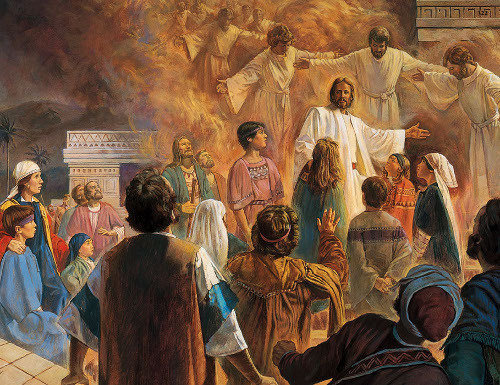
Remnant

Tags

, , , , , , , , , ,

Who exactly are the Lamanites? In the very beginning, Nephi simply referred to those who sought to destroy him as “his brethren.” Nephi’s oldest brother was Laman and it was Laman who should have inherited the role of leader but because Laman was apathetic, slothful and hard hearted, the role was passed to Nephi by the Lord. Thereafter, anyone who dissented, or who joined with any dissenters who fought against the Lord were called Lamanites after the original dissenter, whether they descended from Ishmael, Lemuel, Zoram, etc.

D&C 10:45 Behold, there are many things engraven upon the plates of Nephi which do throw greater views upon my gospel; therefore, it is wisdom in me that you should translate this first part of the engravings of Nephi, and send forth in this work.
46. And, behold, all the remainder of this work does contain all those parts of my gospel which my holy prophets, yea, and also my disciples, desired in their prayers should come forth unto this people.
47. And I said unto them, that it should be granted unto them according to their faith in their prayers;
48. Yea, and this was their faith—that my gospel, which I gave unto them that they might preach in their days, might come unto their brethren the Lamanites, and also all that had become Lamanites because of their dissensions.

Here the Lord declares that all had become Lamanites who dissented from His gospel. Eventually, however, they had all, including the Nephites, become dissenters. But my focus is solely on those who descended from Joseph, namely, Lehi’s descendants.

It is obvious that Lehi had made a serious study of the brass plates, which not only contained his genealogy, but also the law and the prophets and was as current as the time they had left Jerusalem. These plates contained prophets that our own canon in the Bible is lacking. Two prophets, whose writings have been omitted from the Old Testament as we have it, but still quoted were Enoch (quoted in the New Testament) and Zenos (quoted in the Book of Mormon). Lehi understood well Zenos’ allegory of the tame and wild olive trees, all representative of the scattering and gathering of Israel.

One of his youngest sons, Jacob, was so impressed by it that he quoted much, if not the entire allegory, recording it in his own book. Lehi and his family were keenly aware of the implications of this allegory concerning their posterity and it was their most fervent desire that their descendants, being a remnant of Joseph, be forever preserved.

If you are familiar with this allegory found in Jacob 5I am only going to touch on a very tiny portion. I would love to expound on the entire allegory in this chapter, but another time. In D&C, verse 46 above, the Lord declares that it is because of the faith and the prayers of His prophets and disciples that their posterity were preserved, despite the fact that they were ripe for destruction.

Jacob’s own son, Enos, because of his great faith and fervent supplication, was granted this great favor:

Enos 1:11 And after I, Enos, had heard these words, my faith began to beunshaken in the Lord; and I prayed unto him with many long strugglings for my brethren, the Lamanites.
12 And it came to pass that after I had prayed and labored with all diligence, the Lord said unto me: I will grant unto thee according to thy desires, because of thy faith.
13 And now behold, this was the desire which I desired of him—that if it should so be, that my people, the Nephites, should fall into transgression, and by any means be destroyed, and the Lamanites should not be destroyed, that the Lord God would preserve a record of my people, the Nephites; even if it so be by the power of his holy arm, that it might be brought forth at some future day unto the Lamanites, that, perhaps, they might be brought unto salvation—
14 For at the present our strugglings were vain in restoring them to the true faith. And they swore in their wrath that, if it were possible, they would destroy our records and us, and also all the traditions of our fathers.
15 Wherefore, I knowing that the Lord God was able to preserve our records, I cried unto him continually, for he had said unto me: Whatsoever thing ye shall ask in faith, believing that ye shall receive in the name of Christ, ye shall receive it.
16 And I had faith, and I did cry unto God that he would preserve the records; and he covenanted with me that he would bring them forth unto the Lamanites in his own due time.
17 And I, Enos, knew it would be according to the covenant which he had made; wherefore my soul did rest.

There is an unwritten pattern in the Book of Mormon that is discernible to those who know what to look for and this pattern is also found in the Old and the New Testament as well as the Doctrine & Covenants. This pattern is the method that the Lord uses to commune with those who have, through their faith and diligence in obedience, made their calling and election sure and received the Lord as their Second Comforter as the Savior promised his apostles in the New Testament. And thus they become special witnesses and prophets who declare repentance to their people and make the path of the Lord straight among their people.

Enos was one such man who had found favor with the Lord because of his unwavering faith. And the Lord answered him, saying:

18 And the Lord said unto me: Thy fathers have also required of me this thing; and it shall be done unto them according to their faith; for their faith was like unto thine.
19 And now it came to pass that I, Enos, went about among the people of Nephi, prophesying of things to come, and testifying of the things which I had heard and seen.

The Lord declared to Enos that his father Jacob and Jacob’s father Lehi had also desired the same thing and by so acknowledging them, and also by their own words, which we read in the first books of Nephi, we know that they had also received the same gifts.

In Zenos’ allegory, we see that a small part clearly refers to the Nephite/Lamanite nation. Lehi was keenly aware of this and there is no doubt in my mind that he impressed upon his sons the fact that his family was making history and that this small band, making their way out of Jerusalem was fulfilling prophecy! This was also near and dear to Jacob’s heart and we see him expound much in 2 Nephi chapters 6-10.

Back to the allegory that Jacob included in his record. The following verse indicates the fruit of Lehi’s loins:

Jacob 5:25 And he said unto the servant: Look hither and behold the last*. Behold, this have I planted in a good spot of ground; and I have nourished it this long time, and only a part of the tree hath brought forth tame fruit, and the other part of the tree hath brought forth wild fruit; behold, I have nourished this tree like unto the others.

The tame and wild fruits refer to the Nephites and the Lamanites. Lehi and Jacob knew well their part in history and I believe the blessing they most desired of Jesus Christ was to spare their descendants that they do not utterly perish. This also became Enos’ charitable desire. Remember that faith, hope and charity go hand in hand. We cannot see Christ unless we become like Him and charity encompasses qualities that meet this requirement. Enos exemplified charity in his humble request. And so Jesus Christ grants Enos this gift as He also granted it to Jacob and Lehi.

Back to the allegory:

49 And it came to pass that the Lord of the vineyard said unto the servant: Let us go to and hew down the trees of the vineyard and cast them into the fire, that they shall not cumber the ground of my vineyard, for I have done all. What could I have done more for my vineyard?
50 But, behold, the servant said unto the Lord of the vineyard: Spare it a little longer.
51 And the Lord said: Yea, I will spare it a little longer, for it grieveth me that I should lose the trees of my vineyard.

There are times when the Lord sees that his vineyard is completely worthless and ready for the axe/fire. In His mercy, he may allow His servant to intercede. Moses was such an example of the servant of the vineyard as we read in the Old Testament concerning the wicked Israelites:

Numbers 14:11 ¶And the Lord said unto Moses, How long will this people provoke me? and how long will it be ere they believe me, for all the signs which I have shewed among them?
12 I will smite them with the pestilence, and disinherit them, and will make of thee a greater nation and mightier than they.
13 ¶And Moses said unto the Lord, Then the Egyptians shall hear it, (for thou broughtest up this people in thy might from among them;)
14 And they will tell it to the inhabitants of this land: for they have heard that thou Lord art among this people, that thou Lord art seen face to face, and that thy cloud standeth over them, and that thou goest before them, by day time in a pillar of a cloud, and in a pillar of fire by night.
15 ¶Now if thou shalt kill all this people as one man, then the nations which have heard the fame of thee will speak, saying,
16 Because the Lord was not able to bring this people into the land which he sware unto them, therefore he hath slain them in the wilderness.
17 And now, I beseech thee, let the power of my Lord be great, according as thou hast spoken, saying,
18 The Lord is longsuffering, and of great mercy, forgiving iniquity and transgression, and by no means clearing the guilty, visiting the iniquity of the fathers upon the children unto the third and fourth generation.
19 Pardon, I beseech thee, the iniquity of this people according unto the greatness of thy mercy, and as thou hast forgiven this people, from Egypt even until now.
20 And the Lord said, I have pardoned according to thy word

Also:

Psalms 106:21 They forgat God their saviour, which had done great things in Egypt;
22 Wondrous works in the land of Ham, and terrible things by the Red sea.
23 Therefore he said that he would destroy them, had not Moses his chosen stood before him in the breach, to turn away his wrath, lest he should destroy them.

Returning to the allegory:

*verse 63 Graft in the branches; begin at the last that they may be first, and that the first may be last, and dig about the trees, both old and young, the first and the last; and the last and the first, that all may be nourished once again for the last time.

Because of the intercession and intervention of His servants Lehi, and also Jacob and Enos, the Lamanites are allowed to be spared by the Lord as He spared the ancient Israelites for Moses’ sake. And so the final gathering of Israel begins with the Lamanites, bringing us to our day, the latter days.

D&C 49:24 But before the great day of the Lord shall come, Jacob shall flourish in the wilderness, and the Lamanites shall blossom as the rose.

Since those days, the Lamanites, as the Lord describes in D&C, have mingled with many other cultures, including Gentile cultures who have visited from Spain, England, France, etc. having settled in both American Continents in centuries past. As President Spencer W. Kimball once put it:

For a thousand years after the closing of the Book of Mormon record, these people wandered in spiritual darkness and were scattered upon the American continents and the isles of the sea. They lost their written language, their high culture, and, worst of all, their knowledge of the living God and his work. Faith was replaced by fear, rich language by crippled dialects, and an understanding of God and his ways by idolatry, even human sacrifice.

Since the coming of the white man to the Americas, they have been driven mercilessly, killed, and degraded. When Columbus came, these descendants of the Book of Mormon peoples and those with whom they had mixed numbered in the millions and covered the islands of the Pacific and the Americas from Point Barrow to Tierra del Fuego. But the conquerors found a prey, and in the land southward they robbed and despoiled and slaughtered in the name of gold and silver. In the land northward the 400-year “Battle of America” drove the tribal nations, much reduced in numbers, into the far corners of desolate lands. The peoples of the isles of the sea were corrupted by European and American seaman adventurers and were reduced nearly to extinction by disease.

Someone said, “If my pen might have the gift of tears I would write a book and call it ‘The Indian,’ and I would make the whole world weep,” Only the most brazen soul could fail to weep when contemplating the fall of this people, and yet it was the decree of the Lord that the Lamanites should be preserved in the land, that this remnant of Joseph should again come into their promised inheritance…So, my appeal today is for the Lamanites, all the Lamanites, the Mexicans, the Polynesians, the Indians, to live the commandments of God and prove themselves worthy of this choice land. And a further word of caution: Keep your strength up to high purpose. Keep your eye single to the glory of God. Maintain your faith and live the principles of the gospel…

The Lamanites must rise again in dignity and strength to fully join their brethren and sisters of the household of God in carrying forth his work in preparation for that day when the Lord Jesus Christ will return to lead his people, when the millennium will be ushered in, when the earth will be renewed and receive its paradisiacal glory and its lands be united and become one land. For the prophets have said, “The remnant of the house of Joseph shall be built upon this land; and it shall be a land of their inheritance; and they shall build up a holy city unto the Lord, like unto the Jerusalem of old; and they shall no more be confounded, until the end come when the earth shall pass away.” (Ether 13:8)


The New Covenant, Part 3

Tags

, , , ,

Matthew 5:17 Think not that I am come to destroy the law, or the prophets: I am not come to destroy, but to fulfill.

Indeed Jesus Christ fulfilled the law (of Moses) and the prophets (Joshua, Judges, Kings, Samuel, Isaiah, etc), all of who and which pointed toward the coming of a Messiah, a Savior of the world. But the Messiah that the ancient Jews expected was far beyond the mark and they stumbled, failing to realize that their salvation was from sin and death and not the government oppression in which they lived under Roman rule. Their hope of a deliverer took on political undertones and they ignored the spiritual significance of His coming and instead formed expectations of someone mighty who would overthrow their taskmasters and free them from their burdensome yokes.

Isaiah 9:6 For unto us a child is born, unto us a son is given: and the government shall be upon his shoulder: and his name shall be called Wonderful, Counsellor, The mighty God, The everlasting Father, The Prince of Peace.

And so they rejected not only the Son of God, but the heir to David’s throne. Had Jerusalem been a free and independent nation, Jesus Christ would have succeeded Joseph as their rightful king. This the Jews also failed to realize.

Throughout His mortal ministry, He spake to them in parables and symbolism. Those with ears to hear and eyes to see were the meek and the humble seekers. At one point, He explained to them that they had brothers of other nations, for they were of the nation of Judah.

John 10:16 And other sheep I have, which are not of this fold: them also I must bring, and they shall hear my voice; and there shall be one fold, and one shepherd.

Here the Savior confirms what Isaiah and other ancient prophets testified concerning more than one nation or tribe of Israel. And after His resurrection, He fulfills His promise that they would hear His voice. The second fold, or tribe, which He visits is that remnant of Joseph. In the Book of Mormon is a record of Jesus Christ’s visit to these people. Furthermore, He expounded to them their heritage:

3 Nephi 15:13 And behold, this is the land of your inheritance; and the Father hath given it unto you.
14 And not at any time hath the Father given me commandment that I should tell it unto your brethren at Jerusalem.
15 Neither at any time hath the Father given me commandment that I should tell unto them concerning the other tribes of the house of Israel, whom the Father hath led away out of the land.
16 This much did the Father command me, that I should tell unto them:
17 That other sheep I have which are not of this fold; them also I must bring, and they shall hear my voice; and there shall be one fold, and one shepherd.
18 And now, because of stiffneckedness and unbelief they understood not my word; therefore I was commanded to say no more of the Father concerning this thing unto them.
19 But, verily, I say unto you that the Father hath commanded me, and I tell it unto you, that ye were separated from among them because of their iniquity; therefore it is because of their iniquity that they know not of you.
20 And verily, I say unto you again that the other tribes hath the Father separated from them; and it is because of their iniquity that they know not of them.
21 And verily I say unto you, that ye are they of whom I said: Other sheep I have which are not of this fold; them also I must bring, and they shall hear my voice; and there shall be one fold, and one shepherd.
22 And they understood me not, for they supposed it had been the Gentiles; for they understood not that the Gentiles should be converted through their preaching.
23 And they understood me not that I said they shall hear my voice; and they understood me not that the Gentiles should not at any time hear my voice—that I should not manifest myself unto them save it were by the Holy Ghost.
24 But behold, ye have both heard my voice, and seen me; and ye are my sheep, and ye are numbered among those whom the Father hath given me.

Because of the faith of these Nephites and Lamanites, Jesus Christ spent some time with them, blessed them, ministered to them and taught them many things concerning His gospel, including many of the same things He taught to the Jews at Jerusalem. They lived in harmony for several generations until pride and dissentions tore them apart and wars broke out until the wicked remained, who persecuted and exterminated anyone who believed in Jesus Christ.

There was always someone–a prophet, however, who was called to continue writing in and preserving the records of this people, and one of the last of them was named Mormon. He had compiled and abridged a thousand years of records into what we call today, the Book of Mormon. And like Moses, Isaiah and other old world prophets who testified of a Savior of the world, Nephi, Mormon and many other new world prophets in between testified of the same thing–that Jesus is the Christ.

2 Nephi 25:26 And we talk of Christ, we rejoice in Christ, we preach of Christ, we prophesy of Christ, and we write according to our prophecies, that our children may know to what source they may look for a remission of their sins.

The canon (or anthology) of scripture that comprises the Holy Bible and the canon of scripture that comprises the Book of Mormon or as Ezekiel the prophet called the stick of Judah and the stick of Joseph, serve to testify in harmony of the divinity and the mission of Jesus Christ. The coming forth of this new record also ushers in the gathering of all the nations or tribes of Israel in these last days before the great coming of the Lord.

In conclusion, I echo the words of a Nephite prophet who labored much of his life for the welfare of the souls of his countrymen, to gather them by invitation into the Master’s fold:

Alma 5:62 I speak by way of command unto you that belong to the church; and unto those who do not belong to the church I speak by way of invitation, saying: Come and be baptized unto repentance, that ye also may be partakers of the fruit of the tree of life.

The New Covenant, Part 2

Tags

, , , , ,

Many prophets of the Old Testament wrote concerning the scattering of Israel and their eventual gathering in the last days, including Jeremiah, Zephaniah and Isaiah who described the latter day event as a marvelous work and a wonder in conjunction with the coming of a sealed book. Ezekiel prophecied that two nations would each produce their own record testifying of the divinity of Jesus Christ.

In Ezekiel 37 we read:

15. The word of the Lord came again unto me, saying,
16. Moreover, thou son of man, take thee one stick, and write upon it, For Judah, and for the children of Israel his companions: then take another stick, and write upon it, For Joseph, the stick of Ephraim, and for all the house of Israel his companions:
17. And join them one to another into one stick; and they shall become one in thine hand.
18. And when the children of thy people shall speak unto thee, saying, Wilt thou not shew us what thou meanest by these?
19. Say unto them, Thus saith the Lord God; Behold, I will take the stick of Joseph, which is in the hand of Ephraim, and the tribes of Israel his fellows, and will put them with him, even with the stick of Judah, and make them one stick, and they shall be one in mine hand.

We have been promised that the tribe of Judah and the tribe of Joseph would surely testify of Jesus Christ. These old world prophets wrote their words on papyrus, parchment, skins, etc and were rolled on sticks and stored as scrolls when they were not studied. Today, because of the invention of the printing press, we have books.

Nephi, the first recorded prophet of Joseph’s tribe in the new world, wrote the following in 2 Nephi 29 of the Book of Mormon:

12 For behold, I shall speak unto the Jews and they shall write it; and I shall also speak unto the Nephites and they shall write it; and I shall also speak unto the other tribes of the house of Israel, which I have led away, and they shall write it; and I shall also speak unto all nations of the earth and they shall write it.
13 And it shall come to pass that the Jews shall have the words of the Nephites, and the Nephites shall have the words of the Jews; and the Nephites and the Jews shall have the words of the lost tribes of Israel; and the lost tribes of Israel shall have the words of the Nephites and the Jews.
14 And it shall come to pass that my people, which are of the house of Israel, shall be gathered home unto the lands of their possessions; and my word also shall be gathered in one. And I will show unto them that fight against my word and against my people, who are of the house of Israel, that I am God, and that I covenanted with Abraham that I would remember his seed forever.

As mentioned in part one, Lehi took his family out of Jerusalem and from him stemmed two nations–Nephites and Lamanites, both named after two of Lehi’s sons, Nephi and Laman. Eventually the Nephites rejected the Lord and were destroyed by the Lamanites, who eventually became a lost and fallen people on the American continent, but were given a promise that would be fulfilled in the last days.

Today there are no doubt countless millions of Abraham’s seed scattered throughout the earth. And while most of us have forgotten about or are oblivious to the covenant that the Lord made with Abraham and Isaac and Jacob, the Lord certainly has not forgotten His covenant, nor has He ever stopped His work of uniting all His children under this covenant. This has proven to be a major paradigm shift for the humble seekers of the restored gospel of Jesus Christ in the last days.

The New Covenant, Part 1

Tags

, , , , , , , , ,

D&C 84:57 …and remember the new covenant, even the Book of Mormon…

Without a solid understanding of the Old Testament, it is difficult for most Christians to understand the significance of the Book of Mormon. Like the New Testament, the Book of Mormon is another testament or another covenant, even the new covenant, which is essentially the everlasting gospel of Jesus Christ.

We cannot begin to understand who the Nephites and the Lamanites were without first understanding where they came from. Indeed their patriarch, Lehi, did not know until he had obtained a record found on brass plates from the treasury of a military leader named Laban. The Book of Mormon begins with the exodus of a small family led by Lehi from Jerusalem into the wilderness to escape the coming destruction and conquest of Babylon. In 1 Nephi 5:14 Lehi discovers that he is a descendant of Joseph who was sold into Egypt. This was the same Joseph, son of Jacob, father of twelve sons who became nations.

Like their predecessors in the old world, these people had a tradition of memorizing their lineage and later in the Book of Mormon, in Alma 10:3 we learn that Lehi descended from Joseph through his son Manasseh. Joseph, son of Jacob who was renamed Israel by an angel, had eleven brothers. These twelve brothers became the heads of twelve nations or tribes as they are called in the Bible. The Bible as we have it today is a record of the tribe of Judah, or in other words, the Jews.

Before Jacob died, he gathered up his family to bless them and to prophecy what should befall them in the last days. In Genesis 49, he addresses his sons, one by one, including Joseph, who in verse twenty-two declares that he is a fruitful bough, even a fruitful bough by a well; whose branches run over the wall. Jacob continues by saying, “The blessings of thy father have prevailed above the blessings of my progenitors unto the utmost bound of the everlasting hills: they shall be on the head of Joseph, and on the crown of the head of him that was separate from his brethren.”

We read about Israel pleading with the Lord for deliverance in Psalms 80:

“O Shepherd of Israel, thou what leadest Joseph like a flock…Thou hast brought a vine out of Egypt; thou hast cast out the heathen, and planted it…She sent out her boughs unto the sea, and her branches unto the river…”

After Jacob and his family settled into the land of Egypt, more specifically, Goshen, after having been rescued by Joseph from a great famine, this family grew into a people so great that Egypt began to fear them. Thus these Isrealites became enslaved. After many generations, the Lord saw fit to honor his covenant with Abraham and give the land of Canaan to his posterity, the Israelites, for an inheritance. And so Moses brought them out and they traveled for forty long years until they reached their promised land. And because of their wickedness they became scattered over time.

Isaiah is a great prophet who wrote many great things that would soon come to pass. He prophecies many things concerning Israel and the trials they would face because of their wickedness. In chapter sixteen, verse eight, we read, “…they wandered through the wilderness: her branches are stretched out, they are gone over the sea.”

We begin to paint a clear picture regarding the scattering of the twelve tribes of Israel, but more specifically, the tribe of Joseph. It is clear that Joseph is the bough, or in other words a main branch of Israel. And his nation becomes separated from his eleven brethren by the sea. When Lehi departed from Jerusalem, the Lord told him that he was to be given a new land of inheritance. This land of inheritance became Lehi’s promised land–a land across the great sea in the new world.

My mother

Tags

, , ,

Alma 56:47-48 …yea, they had been taught by their mothers, that if they did not doubt, God would deliver them. And they rehearsed unto me the words of their mothers, saying: We do not doubt our mothers knew it.

There is no doubt in my mind that I would not be who I am today if not for the love and faith of my dear mother. But I cannot begin to expound on the man without shedding light on the woman who raised him. In a nutshell, my mother, who was born in Mexico and raised in El Paso, Texas, was converted and baptized into the church as a teenager and soon after decided to serve a mission. She was assigned to Mexico and served faithfully for one and a half years. Thereafter, she met and married my father who was stationed at Fort Bliss and the rest is history.

For as long as I can remember, my mother diligently made sure we were all ready for church every Sunday, prepared family home evening lessons every Monday, gathered us all every night for a family prayer before bed, and so on. She truly was the glue that kept us actively engaged in the gospel of Jesus Christ. I will never forget the stories that she taught us from the Old Testament and also her experiences serving her mission. I knew at a very young age that I wanted to serve a mission, too. There was never a time that my mother did not inspire me. She seldom had free time, but I do remember that whatever free time she had, she spent reading the scriptures.

I also have memories of my family driving over the Rio Grande to Ciudad Juarez to see the sites, shop and just get away for a day. It is a very short drive out of my old neighborhood, down the border highway and across a bridge. It was a much different world back then. It boggles my mind that this Mexican City was dubbed the “Murder Capital of the World.” Interestingly enough, the crime and drug wars all began about the time I left El Paso to serve a mission in Germany for two years and thereafter make a home in Utah. I was sickened over the years to watch on the news of just how bad it really became there. And yet, despite all of this, a temple was built, dedicated and is in full use to this day. Many, if not most members in El Paso do not attend the temple there. Instead, they occasionally schedule bus trips to the next closest temple in Albuquerque, New Mexico for fear of their lives. Not my mom.

Despite the abhorrent crimes committed by drug lords and criminals, my mother has faithfully attended one ore two sessions per month since the temple opened. She told me that another member was driving home not too long ago from the temple and could hear bullets whizzing past his car. But why does my mother continue to go despite the mortal danger? She was promised that if she went straight to the temple and straight back home without deviating to tour, shop, etc, she would be unharmed. And so for the last decade she has carpooled with another sister who is a temple worker there. She tells me these stories and her trips like it’s not a big deal. This is the moral fiber of my mother. This is the woman who was my rock during my childhood. This is the unwavering faith of a daughter of God.

Pictured below: Teotihuacan, Christmas 1970, fifteen months old