Pray and not faint

Tags

, , , , , , , ,

Today we live in a world of automation and instant gratification. Where once it took up to a minute to dial someones telephone number on a rotary phone, today we’re connected at the push of a touch screen icon. Even with the age of the internet and wireless technology we can transfer money between accounts in a matter of seconds. There is no need to wait minutes for a dial-up connection or for an internet page to load. One click and in the blink of an eye, today the page is loaded and ready to browse. You can connect with anyone around the world in seconds where once it required a written letter via air mail that would take between two to three weeks for a single correspondence. Even few people grow their own food when you can go to the nearest burger joint for a meal in under two minutes. We have spoiled ourselves rotten.

We tend to have this same mentality with prayer. We desire something, which in our finite wisdom we think is good, and ask it of our Father in Heaven. We tend to ask with superficial sincerity, with not much more than uttering a couple phrases, as if we were going to withdraw an instant blessing from a heavenly account and not give much more thought after our petition, thinking we’ll get what we prayed for within the next day or week. And when the answer doesn’t come as we expect, we give up asking and rationalize that there is always a reason for everything. That much, however, is true.

More often than not, most people pray hoping for an answer, but seldom, if ever truly praying with faith. There is a distinct difference between praying with hope and praying with faith. Most who pray may not doubt God’s ability to grant requests, but they seldom exercise faith long enough to wait for the right answer. When Jesus Christ walked on the stormy Sea of Galilee, Peter petitioned the Savior to bid him come out onto the water with Him. He hoped that the answer would be yes. Jesus Christ granted his petition but it was not until Peter exercised faith to take that first step, defying the laws of a natural world that he was able to do it. It wasn’t until the storm shook Peter’s faith that he began to immediately sink, even while in the very presence of and within the grasp of his divine mentor.

James 1:5 If any of you lack wisdom, let him ask of God, that giveth to allmen liberally, and upbraideth not; and it shall be given him.
6 But let him ask in faith, nothing wavering. For he that wavereth is like a wave of the sea driven with the wind and tossed.

When people pray for an answer, they may believe that God has the power to grant their request, but seldom do they believe that He will. What, therefore, separates those who receive answers from those who don’t? The primary answer is faith. Faith is evidenced by a person’s actions, not hopes. Peter’s example above illustrates this point. Consider also a Gentile by the name of Cornelius, who was a Roman Centurion, which we read about in the New Testament. It was his humble prayer accompanied by fasting that changed his life. After having fasted for four days, proving his determination to gain an audience with heaven, his petition was answered by a visit from an angel and soon after by the apostle Peter. I have no doubt that Cornelius would have continued fasting for as long as it took for heaven to take notice.

What is it about fasting that focuses or amplifies the power of prayer? By depriving our physical bodies of nourishment, we subjugate the flesh to the spirit. And when we have gained mastery of our physical body by the good desires of our spirit and our heart, the “veil” that separates our mortal world from the eternal and heavenly  sphere becomes thinner, making communication with heaven more powerful.

Lorenzo Snow, a young missionary in Italy, was faced with a dire situation. A young boy was sick on his death bed, surrounded by grieving family members. Snow knew that he had the priesthood power as the apostles of old did to heal this boy, but he first had to know the will of the Lord. Sometimes it is appointed to us to leave this mortal world. But if not, then petitions are granted. The next day, Lorenzo fasted and went alone to pray outside the town, alone in the mountains. He was determined not to move until he had received an answer, whether it was yes or no. He struggled six long hours in fervent prayer until finally his answer came. He returned to the home of the boy with the approval from God, and with his priesthood authority, laid his hands on the boy and healed him.

Seeking first the Lord’s will is another key that separates those who receive answers from those who don’t. Furthermore, we must accept that the answer is not one we will always want to hear. Sometimes, the answer will be no. When Jesus Christ bled from every pore in Gethsemane, He prayed that His bitter cup be removed. He had had enough and wanted to stop. Yet He knew what His Father’s will was and because of His love for his Father in heaven, he continued, “not my will but thy will be done.” And so He finished what He started and became the Savior of mankind.

If we truly received the answers to all the prayers we ever uttered, I think our world would be in much greater chaos than it is today for it is because of free will that God allows us to manage ourselves for the most part. But for the few who truly receive answers, it is because of hope and their exercise of faith AND because they have come to understand God’s will, especially in the matters of their own personal lives, AND aligning their own will with that of God’s that they receive answers.

Sometimes prayers are answered immediately if expedient in the Lord at the time. Such was the case as I shared in a recent entry, A humming bird and a prayer. It has not always been the case. I have literally prayed for hours before finally receiving a definitive answer. And sometimes, most of the time, the answer is no. We also have to accept the fact that God sees beyond the horizon. His wisdom and foresight is infinitely greater than our own. I have come to accept this in my life as I continually refine my own desires and I align them with His will and His work.

His ultimate desire for each of us is to bring us back into His presence. And so He has given each of us a set of trials, weaknesses and obstacles to overcome so that we become mindful of Him and continually turn to Him for guidance. For many, however, especially those who do not understand how the Lord operates, it becomes a bitter experience, which leaves them cynical and doubting.

But for the humble followers, the meek believers who endure patiently, with longsuffering and love for others, who follow Christ’s example and way of life, who by these virtues become more Christlike, answers come more readily, typically because they are offered, not on behalf of themselves, but on behalf of and for intercession of others, for they have become true servants of their fellow man, concerned not for their own personal gain, but for the welfare of others.

Moriancumr received all that he desired:

Ether 1:43 And there will I bless thee and thy seed, and raise up unto me of thy seed, and of the seed of thy brother, and they who shall go with thee, a great nation. And there shall be none greater than the nation which I will raise up unto me of thy seed, upon all the face of the earth. And thus I will do unto thee because this long time ye have cried unto me.

Nephi also had received answers to great questions:

1 Nephi 16 And it came to pass that I, Nephi, being exceedingly young, nevertheless being large in stature, and also having great desires to know of the mysteries of God, wherefore, I did cry unto the Lord; and behold he did visit me, and did soften my heart that I did believe all the words which had been spoken by my father; wherefore, I did not rebel against him like unto my brothers…
19 And it came to pass that the Lord spake unto me, saying: Blessed art thou, Nephi, because of thy faith, for thou hast sought me diligently, with lowliness of heart.

Enos also received an answer to a prayer:

2 And I will tell you of the wrestle which I had before God, before I received a remission of my sins.
3 Behold, I went to hunt beasts in the forests; and the words which I had often heard my father speak concerning eternal life, and the joy of the saints, sunk deep into my heart.
4 And my soul hungered; and I kneeled down before my Maker, and I cried unto him in mighty prayer and supplication for mine own soul; and all the day long did I cry unto him; yea, and when the night came I did still raise my voice high that it reached the heavens.
5 And there came a voice unto me, saying: Enos, thy sins are forgiven thee, and thou shalt be blessed.
6 And I, Enos, knew that God could not lie; wherefore, my guilt was swept away.
7 And I said: Lord, how is it done?
8 And he said unto me: Because of thy faith in Christ, whom thou hast never before heard nor seen. And many years pass away before he shall manifest himself in the flesh; wherefore, go to, thy faith hath made thee whole.

Enos had faith. He hoped that he would receive an answer. He knew that God could answer. But it was his exercise of faith, knowing that God would answer, to stay on his knees until he received an answer, which he finally did just as Lorenzo Snow, Nephi, Moriancumr and many others throughout history who proved themselves worthy of divine attention.

Throughout written scripture we read over and over where we should “pray and not faint.” What this simply means is to be ever drawn to our Father in heaven in prayer, that our thoughts always be directed to Him. To faint means to falter, to give up, to lose hope, to lose courage.  Nephi sums it up this way:

2 Nephi 32:8 And now, my beloved brethren, I perceive that ye ponder still in your hearts; and it grieveth me that I must speak concerning this thing. For if ye would hearken unto the Spirit which teacheth a man to pray, ye would know that ye must pray; for the evil spirit teacheth not a man to pray, but teacheth him that he must not pray.
9 But behold, I say unto you that ye must pray always, and not faint; that ye must not perform any thing unto the Lord save in the first place ye shall pray unto the Father in the name of Christ, that he will consecrate thy performance unto thee, that thy performance may be for the welfare of thy soul.

According to Vines Dictionary of NT Words, page 400, enkakeo (Greek word for faint), means to “lack courage, lose heart, be fainthearted.”

It is all to easy for us to become distracted by the shiny things of the world, to become idle, idolatrous, lazy, indifferent, etc. But if we remain focused, especially when we pray with righteous desires, and if we never doubt, as James in the New Testament warns, we will always receive an answer. But we must prove ourselves ready and willing to act upon that answer. Where much is given, much is required.

So how should we pray then? For me, I find that I need a quiet time of the day, usually in the very early hours of the morning (usually between 1 to 5 AM or so) on weekends where I can be alone in silence, and can focus and ponder my life, my struggles, my desires, etc. and where I can peacefully search the scriptures. It is during this time that I can prepare myself mentally and spiritually to approach the Lord in prayer. Sometimes I will go to a quiet corner of my home, where I like to read by the window or I will go outside on a swing chair. The greater the matter that I take up with heaven, the more time I give myself to be alone. Sometimes an entire weekend alone isn’t enough. But with enough solitude, the proper state of mind and heart, preparation and fasting, I know that I will get an answer. One of my greatest desires, if not the greatest, has yet to be granted. But I know that my feet are on the path to being granted this desire. It is partly the reason that I have created this blog. I only hope that along the way, I will have shed a broad enough light that many others may benefit from it.


Prince Ammon

Tags

, , , , ,

Throughout scriptural history, we read about lineages and genealogies, whether in the Old Testament or in the New Testament. It was evidently customary for the nations of Israel to recognize who was the son of who as far back as tradition holds. This is how we learn in the first chapter of Matthew of Jesus Christ’s birthright to the throne of David, had He chosen to claim it.

When Mosiah discovered the land of Zarahemla, he learns of their genealogy after they had been taught the language of the Nephites and this is how they learned of their common history. There are examples in the Book of Mormon where someone recited his lineage before declaring his message. I believe that Ammon, the eldest son of King Mosiah, was being modest in his record keeping and left out a few parts. I think his introduction to the Lamanite king was more ceremonial than we read about.

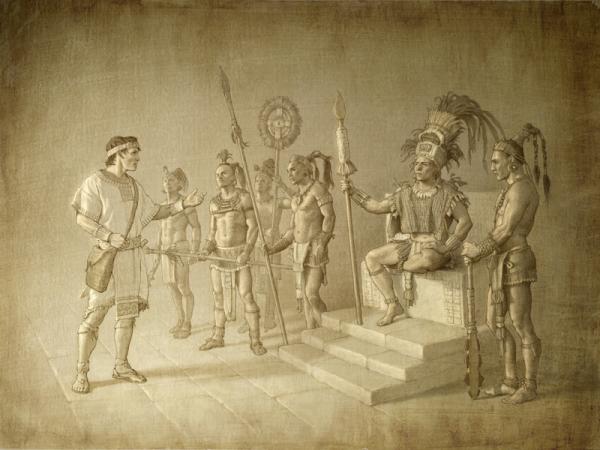
I believe it went something like this: Ammon is brought bound before the king and he bows before Lamoni, recites his lineage as it is customary in the land. “Behold, O king, I am Ammon from the land of Zarahemla. I am the son of Mosiah, who is the son of Benjamin, who is the son of Mosiah…who was the son of Lehi who came out of Jerusalem during the reign of King Zedekiah.” And thus we discover that Lamoni was a descendant of Ishmael. Lamoni, the son of the king over all the Lamanites in the land of Ishmael was not ignorant of who the king of the Nephites in Zarahemla was and that before him knelt the heir to the throne in Zarahemla. Lamoni must have thought, “What does the prince of the Nephites want to do with us?”

Alma 17:22 And the king inquired of Ammon if it were his desire to dwell in the land among the Lamanites, or among his people.
23 And Ammon said unto him: Yea, I desire to dwell among this people for a time; yea, and perhaps until the day I die.

Lamoni, awestruck, was impressed–so impressed that he has Ammon’s bands removed.

24 And it came to pass that king Lamoni was much pleased with Ammon, and caused that his bands should be loosed; and he would that Ammon should take one of his daughters to wife.

I don’t think Lamoni was so intent on uniting kingdoms as he was simply wishing to honor the young prince in return. But Ammon politely declined, either because he was already married, perhaps with children back in Zarahemla, or his mind was otherwise simply single in purpose. His only desire was to serve and not rule. And he became King Lamoni’s servant by tending his flocks of sheep. What a fitting task for one who became a shepherd of a Lamanite nation. By the time he had proven himself a strong and loyal servant, his strength and royalty had been acknowledged and recognized:

Alma 18:13 And one of the king’s servants said unto him, Rabbanah, which is, being interpreted, powerful or great king, considering their kings to be powerful; and thus he said unto him: Rabbanah, the king desireth thee to stay.

“Ammon and Lamoni” by Joseph F. Brickley:

I believe it is reasonable to conclude that Ammon had indeed remained with this people after having served them for fourteen years in their land, even long after having brought them back to the land of Zarahemla to inherit the land of Jershon and and lived with them, becoming their high priest. If he was still alive when they migrated north after the civil wars, it is possible that he and his family departed with them:

Helaman 3:12 And it came to pass that there were many of the people of Ammon, who were Lamanites by birth, did also go forth into this land.

A hummingbird and a prayer

Tags

, ,

I really try not to put a big light on myself as a person and I don’t care what critics and naysayers think about me. But I do not shy away from holding up my light rather than hiding it under a bushel. The light that I hold up is my Savior, Jesus Christ, and what He has done for me in my life. And maybe one day, I will share everything that I have seen and heard, but today I feel impressed to share one small experience.

It was May 6, 2008 when I was in my garage doing some work, as well as in the yard getting my sprinkler system fixed. I heard something, which startled me and when I looked up I saw a hummingbird hovering around the ceiling. It was the rapid flapping that had caught my attention. It flew back and forth trying to find a way out. The garage has a twelve foot high ceiling so the top of the main garage door opening, which was shielded by the open door, which hung above me, was a good four feet below the ceiling line.

It darted back and forth and it didn’t take long to realize that there was no way it would find it’s way out. I grabbed my snow shovel and lifted it up to try and guide it in the right direction, but all I managed to do was frighten it. Still I tried gently coaxing it for a while, hoping that I could get it to fly low enough to see the giant 8’x16′ garage door opening and fly outside. It just wasn’t working. I kept trying to think of different approaches, but there simply wasn’t one that wouldn’t hurt it or even scare it more.

I know that the Lord is aware of all His creatures including this little hummingbird. I figured the simplest, though not necessarily the easiest way to do this was to take it in my hand and walk outside with it and release it. I prayed to God and I told Him that I couldn’t think of any other way to help it. Anything that finds its way into my garage eventually dies from the heat in the summer and I didn’t want the the hummingbird to die, too, so I asked for help. I needed this little bird to trust me.

Just as soon as I had prayed, the hummingbird landed on a wire hanging above the motor of my garage door opener. It sat there and just looked at me. I knew this was my chance. I slowly climbed up on the hood of my car and crawled up the windshield towards it as it looked straight at me. By now I was just a few feet away from it. I reached past the garage door motor and wrapped my hand around its little body. I braced myself, being in a awkward position, to keep from falling or sliding off my car and with my other hand I gently unwrapped its tiny feet from the wire as it did not seem to want to let go.

I was elated as I looked at the little guy just barely poking its head through my fingers. I couldn’t get over how tiny it was inside my hand. I carefully climbed back down my car and walked outside as it peeked through my fingers. It was a beautiful iridescent green in color. I opened my hand and watched it fly away. It was such a cool experience! I was thankful that God answered my prayer and I know that He cares about all of His creatures, even as tiny as a hummingbird. Because of this and many other personal experiences, I know that anything that we ask of God is granted us, if it is expedient in Him, if we ask in faith. Not all prayers are answered as quickly. I’ve literally spent hours at a time on my knees praying before finally receiving an answer. This particular experience at this particular point in my life reassured me that God is aware of me.

Edit: It’s been over a year since I published this post that the Lord taught me why He gave me this experience. Like the hummingbird, I have always struggled to be attentive. And although I am a tiny part of this world, I am not insignificant. Most importantly, it has taught me the importance of being still so that I can know God. I have learned to recognize His hand in my life. That little hummingbird, prone to getting itself into trouble is me.


A Centurion’s Faith

Tags

, , , ,

There are very few Centurions mentioned by name in the New Testament. In the gospel according to Luke, a certain Centurion, who upon hearing that Jesus Christ had come into Capernaum, immediately sent the elders of the Jews to plead with the Savior to heal a servant of his, who was sick unto death. In a very few verses, we can feel the love of this Roman leader for those in his house, especially for his dying servant, who was especially dear to him.

In Luke 7, we read:

4 And when they came to Jesus, they besought him instantly, saying, That he was worthy for whom he should do this:
5 For he loveth our nation, and he hath built us a synagogue.

The Jews at this time were not known for their affection toward their rulers or for keeping company with anyone of another nation or Gentile, considering them all unclean.  But these elders, being as it were, teachers and shepherds of their flocks, truly favored their commander. He had paid to have a place of worship built for them and proved to be a good caretaker. They emphasized his love for the people of Judah.

6 Then Jesus went with them. And when he was now not far from the house, the centurion sent friends to him, saying unto him, Lord, trouble not thyself: for I am not worthy that thou shouldest enter under my roof:

There is no doubt in my mind that he was familiar with their customs and knowing only by word of mouth that the Son of God was approaching, he sent others to stop him from entering his home, or perhaps even setting foot on his property. For perspective, let’s look at another Centurion, Cornelius, who was ministered to by an angel and also by the apostle Peter in Acts 10:

25 And as Peter was coming in, Cornelius met him, and fell down at his feet, and worshipped him.
26 But Peter took him up, saying, Stand up; I myself also am a man.
27 And as he talked with him, he went in, and found many that were come together.
28 And he said unto them, Ye know how that it is an unlawful thing for a man that is a Jew to keep company, or come unto one of another nation; but God hath shewed me that I should not call any man common or unclean.

To make the long story short, after having been ministered to by an angel, Peter taught Cornelius, who had fasted for four days, and baptized him and others. This is a great chapter and worth reading to understand the full context of the story.

As illustrated, I believe that the Centurion who’s servant was dying, knew that it was unlawful for a Jew to keep company with a Gentile, and the Centurion out of great respect did not want to make such an imposition upon Jesus Christ. And believing their tradition, he felt himself especially unworthy of His divine presence.

7 Wherefore neither thought I myself worthy to come unto thee: but say in a word, and my servant shall be healed.

He acknowledges Christ’s divine power that a simple word spoken is all that is needed. Indeed if the emperor of Rome spoke a word, it became law. Furthermore, he acknowledges the Savior’s authority:

8 For I also am a man set under authority, having under me soldiers, and I say unto one, Go, and he goeth; and to another, Come, and he cometh; and to my servant, Do this, and he doeth it.

When Peter smote off the ear of a man in Getheseme in a misplaced desire to defend Jesus Christ from being arrested, the Savior explains the following to Peter:

Matthew 26:53  Thinkest thou that I cannot now pray to my Father, and he shall presently give me more than twelve legions of angels?

A Centurion commanded an army of up to one hundred men known as a Century. There were various divisions known as Centuries, Cohorts, Legions, etc. A Legion typically consisted of approximately six thousand men comprising Centuries, Cohorts, and Horsemen. Twelve legions of angels would easily consist of 7,200 angels, six thousand for the Savior as well as for each of His apostles, excluding, of course, Judas, a traitor who stood opposite the Lord.

The Centurion was accustomed to commands and obedience to commands whether coming from his own superiors or whether he issued those commands himself. He is basically telling Jesus Christ that as men obey him, so would this sickness obey Christ. A simple word from the Master, and it was as good as done. This Centurion, who did not consider himself worthy of the Son of God’s presence, yet was considered worthy by his own friends and especially the elders of the Jews, displays the kind of meekness and humility which Christ had recently preached in His sermon on the mount.

9 When Jesus heard these things, he marvelled at him, and turned him about, and said unto the people that followed him, I say unto you, I have not found so great faith, no, not in Israel.
10 And they that were sent, returning to the house, found the servant whole that had been sick.

Jesus Christ taught that of such is the kingdom of heaven. His astonishment at the humility of a Gentile invoked from the Savior the same compassion, which the Centurion held for all those in his house. This is the kind of love and compassion, which Jesus Christ continually displayed for others. This Centurion was likely among  the first fruits of the coming Gentile harvest.

I can only imagine that the joy, which the Centurion felt when his servant was made whole will be very similar to the joy our Savior will feel when we are made whole and brought back into His presence. His servant, through the merits of Jesus Christ, overcame death and through His merits we will also overcome death and likewise be brought back into His presence one day.

The Brigham City Temple

Tags

, , , , ,

The Temple and its purpose has been an integral part of the gospel of Jesus Christ since the days of the ancient prophets of the Old Testament. Indeed Moses was commanded to build a tabernacle so that He could dwell among the congregation of  Israelites as He lead them to their promised land.

Exodus 25:8  And let them make me a sanctuary; that I may dwell among them.

The Lord also instructed Solomon to build a temple–a house of the Lord, which was completed about 1,000 BC and stood until it was destroyed by fire during the Babylonian conquest approx. 600 BC. It was rebuilt thereafter under Cyrus, who allowed the Jews to return to Jerusalem and later under Darius roughly 500 BC.

Ezra 1:2 Thus saith Cyrus king of Persia, The Lord God of heaven hath given me all the kingdoms of the earth; and he hath charged me to build him an house at Jerusalem, which is in Judah.

The temple at Jerusalem was central to the life of the Jews where sacred ordinances were performed for the benefit of man. Jesus Christ spent time as well teaching therein as did His apostles.

Luke 19:47 And he taught daily in the temple…

Acts 5:42 And daily in the temple, and in every house, they ceased not to teach and preach Jesus Christ.

Not long after Jesus ascended into heaven, the temple was destroyed again by the Romans in 70 AD. His apostles had all, except for John, been killed because of their faith. Temple ordinances and the authority to perform them had become lost, but would not be lost forever. Isaiah prophesied that the temple would return in the last days.

Isaiah 2:2 And it shall come to pass in the last days, that the mountain of the Lord’s house shall be established in the top of the mountains, and shall be exalted above the hills; and all nations shall flow unto it.
3 And many people shall go and say, Come ye, and let us go up to the mountain of the Lord, to the house of the God of Jacob; and he will teach us of his ways, and we will walk in his paths: for out of Zion shall go forth the law, and the word of the Lord from Jerusalem.

Like the temple at Jerusalem, which was built on Mount Moriah, thus being called the mountain of the Lord’s house, a temple was built in the top of the mountains after the latter-day saints were killed, persecuted and driven from state to state until they migrated to what is now the state of Utah, settling in the Salt Lake Valley along the Wasatch Mountains. This range spans 220 miles from Mt. Nebo on the south end near Nephi all the way to the craggy Sheep Rock point in Soda Springs, Idaho on the north end. Since then many temples have been built along this western range of the Rocky Mountains as well all around the globe among all nations as the Lord intended:

Mark 11: 17 And he taught, saying unto them, Is it not written, My house shall be called of all nations the house of prayer?

Today in the temple, the Lord communes with those who, with a broken heart and contrite spirit, come unto Him. The ordinances therein, being ceremonial, are merely the “endowments” or the “gifts” that we are given, which prepare us for the actual event, which is returning to His presence. He does this just as He did with the Israelite congregation who followed Moses through the wilderness who abode His laws–prerequisites for such divine blessings.

Some ordinances include baptism for those who have died without the gospel of Jesus Christ in their lives–

1 Corinthians 15:29 Else what shall they do which are baptized for the dead, if the dead rise not at all? why are they then baptized for the dead?

–Because He died for everyone, not only those who believe in His name or know Him. A loving God is no respector of persons and esteems all of us equally. For this reason, Jesus Christ preached to those souls who went to prison rather than paradise after He was crucified.

1 Peter 3:18 For Christ also hath once suffered for sins, the just for the unjust, that he might bring us to God, being put to death in the flesh, but quickened by the Spirit:
19 By which also he went and preached unto the spirits in prison;
20 Which sometime were disobedient, when once the longsuffering of God waited in the days of Noah, while the ark was a preparing, wherein few, that is, eight souls were saved by water.

Like the the apostles of old, who taught in the temple, so are we taught in our temples today and prepared to return to a loving Father in Heaven. One of the most important ordinances that only happen in the temple are being sealed to our families for time and all eternity. It was in a temple that I was sealed to my wife, Lori, for time and all eternity and not just until death do we part. The gospel of Jesus Christ was designed to bring us all back to our Father’s kingdom to dwell with Him throughout eternity. It has been a great blessing to watch the temple being built the last couple years. The Brigham City Temple will be dedicated to the Lord’s work tomorrow, September 23, 2012. It will be open on Tuesday, September 25th for its first session. I have reserved a morning session and I look forward to communing with the Lord therein and very often after that.

My parents visited very recently and the day before they flew back to Texas, we had a small window of opportunity to do a quick photo shoot. It was still relatively early in the morning and I hoped it wouldn’t be too dark and overcast. It was a bit darker than I had hoped, but the cloudy overcast made quite a beautiful backdrop for the pictures we took that morning:

The Brigham City Temple

Lori and me:

Dad and Mom:

All of us: